
Content verified by

What is transcatheter aortic valve implantation?
Transcatheter aortic valve implantation (TAVI) is a minimally invasive non-surgical procedure in which a new aortic valve is inserted into your heart to treat severe aortic stenosis. TAVI is sometimes referred to as TAVR, which stands for transcatheter aortic valve replacement.
TAVI is an alternative to surgical aortic valve replacement for severe symptomatic aortic stenosis. Our heart specialists may recommend TAVI instead of surgery depending on a range of factors, such as your age, overall health and valve anatomy.
Our consultants at Harefield and Royal Brompton hospitals are at the forefront of minimally invasive, non-surgical procedures to treat severe symptomatic aortic stenosis.
Experts in TAVI
Our world-renowned cardiologists offer:
- minimally invasive TAVI to treat severe symptomatic aortic stenosis
- short-notice appointments, available in as little as 24 hours
- fast access to treatment

What is aortic stenosis?
Aortic stenosis is a common heart condition where the aortic valve is stiff and narrowed. Calcium deposits make the flaps of tissue thicken and stiffen. The aortic valve can’t open properly and narrows, restricting blood flow.
Aortic stenosis is progressive and, without treatment, will get worse over time. In more advanced stages, the condition is called severe aortic stenosis, which can be symptomatic (causes symptoms) or asymptomatic (without symptoms).
When symptoms are present, they can include breathlessness, chest pain, fatigue (tiredness) and episodes of fainting. As the heart has to work harder to pump blood around your body, it can put a strain on the heart muscle. Over time, this can lead to heart failure and dangerous arrhythmias.
The most effective treatment for severe symptomatic aortic stenosis is to replace your aortic valve, either through surgical aortic valve replacement (heart surgery) or a minimally invasive procedure called TAVI.
If you are not experiencing symptoms with severe aortic stenosis, you may not need treatment straight away. Instead, our consultants may recommend careful monitoring unless there are signs that your heart is being affected.
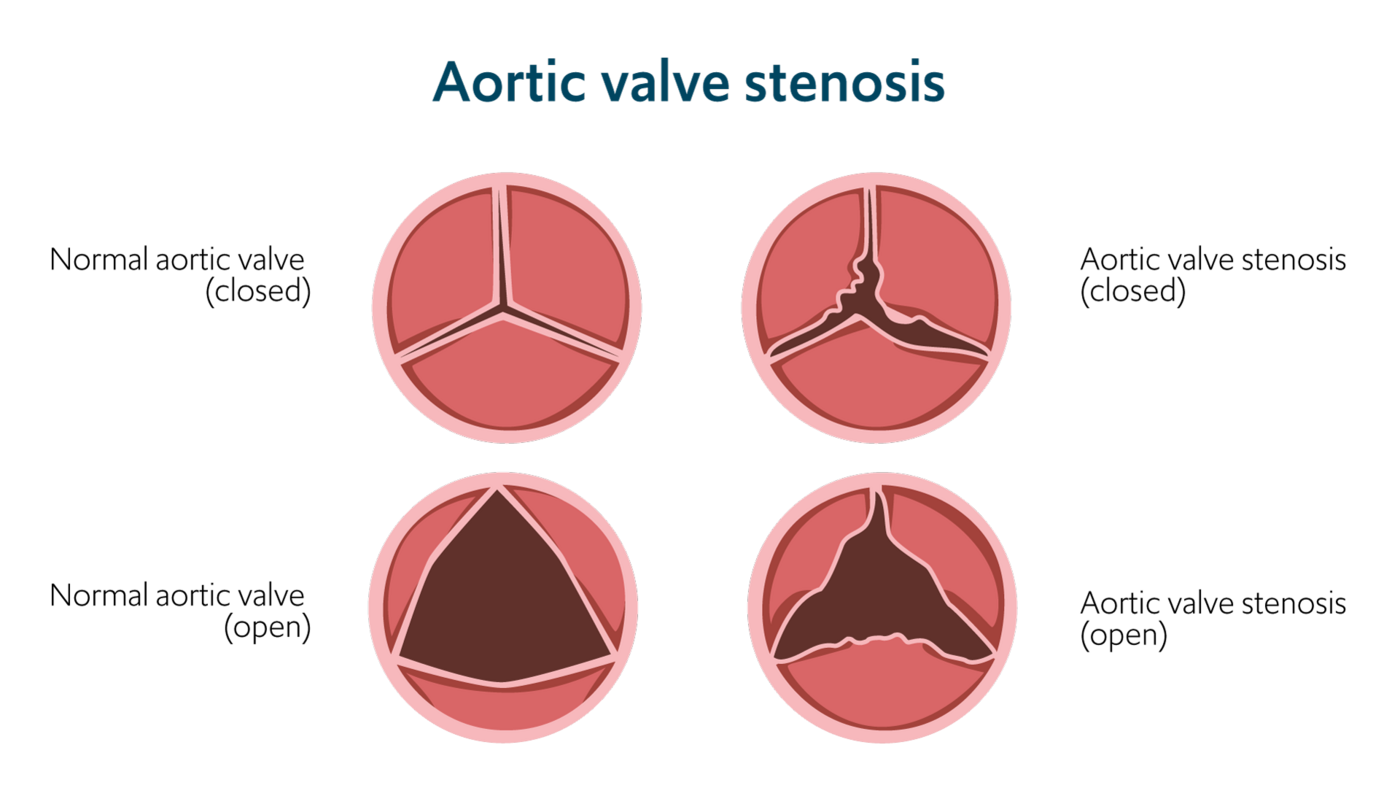
Aortic valve stenosis causes the valve to become narrowed, reducing blood flow through the heart.
Who is TAVI recommended for?
TAVI is used to treat severe symptomatic aortic stenosis. The procedure can improve quality of life and life expectancy for those with the condition.
As the TAVI procedure is minimally invasive and usually performed using local anaesthetic (meaning you are awake throughout), it may be recommended instead of surgical aortic valve replacement (SAVR) in selected patients, as both procedures treat the same condition.
Our consultants will review your surgical risk as part of decision making for TAVI:
- High surgical risk: These are usually patients that are older or who have medical conditions that makes SAVR too risky to perform. TAVI is often the preferred option for these patients.
- Intermediate surgical risk: These are patients that could have SAVR but carry a moderate risk with surgery. Our consultants may recommend TAVI following a personalised assessment.
- Low surgical risk: These are patients that are fit for surgery and could have SAVR. However, TAVI may be an option in selected patients, because it is a less invasive procedure and recovery is often quicker.
In addition to surgical risk, other factors such as your valve anatomy (for example, if your aortic valve is too small or large for the replacements available) will be considered.
In rare cases, TAVI may be considered for carefully selected patients with aortic regurgitation. However, this is not the indicated use for the treatment.
If you would like a personalised assessment for the TAVI procedure by one of our leading heart specialists, please contact us to arrange an appointment.
What to expect during TAVI
When you are referred for a TAVI, our multidisciplinary team of specialists will carefully evaluate your case and advise on the best strategy to suit your anatomy as part of a personalised assessment. Our consultants are extremely experienced in all procedures for aortic valve replacement and will be able to offer an unbiased opinion based on the current best available scientific evidence.
Once the strategy has been agreed, the intervention on your heart will be performed to the highest standards in our state-of-the-art facilities.
Our specialists will usually perform TAVI under local anaesthetic in the cardiac catheter laboratory, or ‘cath lab’, so you will be awake throughout the procedure. However, general anaesthetics are available if that’s better for your needs (where you can be asleep during the procedure).
We will make a small cut over a blood vessel (around 1cm), usually in your groin or shoulder. Our specialists will then insert fine flexible tubes called catheters into the artery and vein at the site. This allows us to to give any necessary drugs safely, access the heart to implant the valve, and fit a temporary pacemaker if they need to stabilise your heart’s rhythm.
The replacement valve is made of animal tissue – either porcine from pigs or bovine from cows. Using X-ray video guidance, our specialists carefully guide the catheter through the artery to your heart. When the catheter reaches the damaged or diseased aortic valve, they implant the new valve.
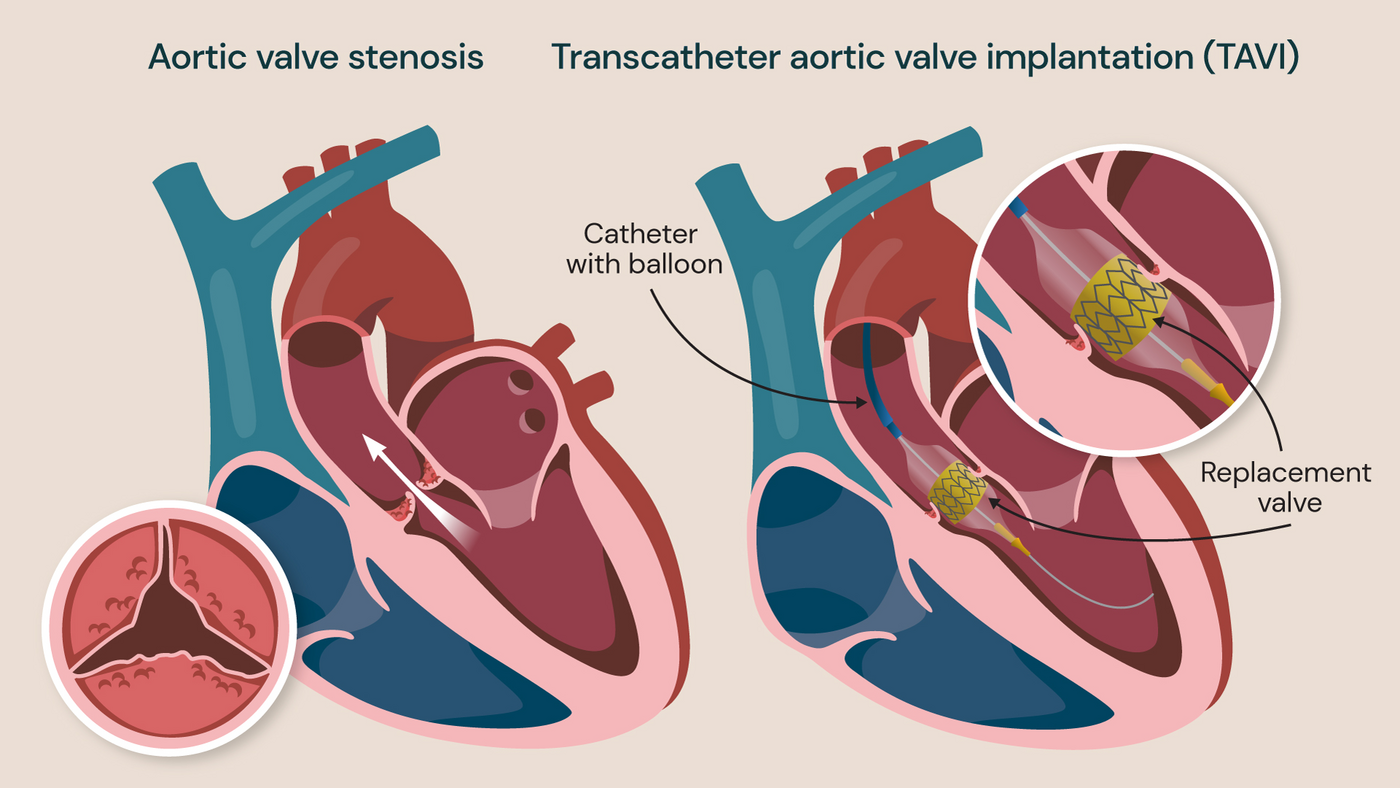
TAVI procedure: A new valve is inserted in position using a catheter.
Depending on the type of valve chosen, it will either expand spontaneously, or our consultants will use a balloon to open the valve when in the correct position. The replacement valve is mounted within a small metal mesh tube (called a stent), which helps hold it in place once it has been positioned in your heart.
Finally, our consultants will check that the new aortic valve is working, withdraw the catheter and close the incision. Both the valve and the stent will remain in your heart for the rest of your life.
If you have severe symptomatic aortic stenosis and feel you could benefit from TAVI, our specialists can help. Get in touch with our team to book an appointment.
How to prepare for TAVI
Before the procedure, our cardiology team will arrange investigations to confirm your diagnosis, assess the severity of your aortic stenosis and check your general health. They will discuss the results with you and decide whether TAVI is the best treatment for your needs. Investigations could include:
- blood tests
- ECG
- chest X-ray
- echocardiogram
- angiography
- cardiac MRI scan
- CT scan
- lung function tests
- exercise stress tests
Before your procedure, you should try to improve your health and prevent complications. It can help to:
- stop smoking to reduce breathing problems and improve healing
- aim to reach a healthy BMI if you are overweight; it will reduce the risk of the procedure
- have a dental check-up – tooth and gum disease can allow bacteria to enter the bloodstream and infect your new valve, a dangerous condition known as endocarditis
- see your GP to ensure any chronic medical problems like hypertension, bronchitis, and diabetes are well controlled
- shower carefully the evening before and the morning of your TAVI, to protect against infection. Pay careful attention to the skin creases in the armpits, groin, genitals and under your breasts
Recovery from TAVI
After your TAVI, our cardiology team will monitor and support you in the recovery unit. You will have a drip for fluids and antibiotics, as well as a monitor to show your heart’s rate and rhythm. When you are stable, they will transfer you to the ward.
You will have a dressing over the wound and may notice some pain and bruising at the insertion site. This should get better over the first few days. The team will give you painkillers and ensure you’re comfortable.
Most people can go home 1 to 3 days after a TAVI procedure. Our team will arrange a follow-up appointment and an echocardiogram to check that the valve is working well.
If you feel unwell or have any concerns, contact the hospital, your GP or go to the nearest accident and emergency department.
Benefits of TAVI
There are many benefits to using the TAVI procedure to treat severe symptomatic aortic stenosis.
The TAVI procedure is less invasive than SAVR, involving only a small incision of around 1cm to access the blood vessels needed. As a comparison, SAVR is performed through a surgical incision down the centre of the breastbone or, if eligible, through a minimally invasive approach with a small incision of 5-7cm between the ribs.
TAVI is also usually performed with local anaesthetic rather than general anaesthetic, meaning that patients are awake throughout the procedure. In addition, TAVI is associated with a shorter hospital stay of around 3 days, compared with 7 days for SAVR.
For high-risk patients (patients who may not be suitable for surgery or are at a higher risk of complications), studies show that the TAVI procedure improves survival and symptoms when compared to medical therapy alone.
For low- and intermediate- risk patients (patients who are still suitable for surgery), a 2025 meta-analysis (which is a review of the best evidence available) has shown that the TAVI procedure is associated with a lower risk of death or stroke 1 year after the procedure when compared to similar patients who receive SAVR. Separate studies also demonstrated that quality of life improved for these patients following TAVI.
The valves used for the TAVI procedure have shown good durability in long-term studies. Current evidence demonstrates that they can last for 5 to 10 years. As a comparison, the valves used in SAVR typically last 10 to 15 years. However, more studies are being conducted to determine TAVI valve durability beyond 10 years, which is an important consideration for younger patients.
Risks of TAVI
All medical procedures have risks. Our team will work to reduce any complications and support your healthy recovery.
The risk of complications with TAVI depends on your general health and the health of your heart. People who have existing medical conditions may be more vulnerable to problems. You can talk to our consultants about the risks and benefits of TAVI as part of a personalised assessment.
Potential complications include:
- bleeding, bruising or infection at the access site
- 1 in 20 people will have damage to an artery that needs repair
- slow or irregular heart rate. 5-10% of people will need a permanent pacemaker to correct this
- heart attack affects less than 1 in 100 people (0.7%). The doctor will usually open up the blocked blood vessel with angioplasty and insert a stent
- allergy to the dye used during angiography
- if you develop complications during surgery, you may need open-heart surgery. This happens to less than 1% of patients
- stroke – around 3% of people having TAVI have a stroke
- acute kidney failure, which is more common in people with impaired kidney function
- sadly, complications following TAVI may lead to death. Between 1% and 4% of people will die within 30 days of the procedure
If you would like to speak to one of our heart specialists about your suitability for the TAVI procedure, we can help. Contact our team to arrange an appointment.
Reviewed regularly to reflect clinical best practice
Last reviewed: 27 July 2026
Locations
Explore our team of heart specialists
Meet our team of renowned heart specialists. From cardiovascular health assessments to innovative interventions, our experts are committed to delivering personalised care designed just for you.