
Content verified by

What is a tummy tuck?
A tummy tuck, or abdominoplasty, is a plastic surgery procedure that removes excess skin and fat from your abdomen. It can enhance the shape and look of your abdomen, strengthen abdominal muscles, and reduce the risk of skin infections in any folds of abdominal skin.
During a tummy tuck procedure, our plastic surgery specialists will often tighten the surrounding connective tissues simultaneously and reposition the remaining skin to create a toned look.
We have one of the largest plastic surgery services in the UK at Guy’s and St Thomas’ hospitals. Our highly skilled plastic surgeons are leaders in their field and are committed to providing you with personalised care and excellent results.
Experts in tummy tuck procedures
Our plastic surgery specialists offer:
- short-notice appointments
- mini, full, extended and fleur-dis-lis tummy tuck procedures
- fast access to treatment

Why might a tummy tuck be performed?
A tummy tuck might be performed if you have excess skin with poor elasticity or weakened connective tissue in your abdomen.
Weight changes (drastic weight loss), pregnancy and ageing usually cause these issues.
Types of tummy tuck
There are different types of tummy tuck procedures that our plastic surgeons may recommend, depending on how much excess skin you have, where the loose skin is, and your body shape and goals. These include a mini tummy tuck, full tummy tuck, extended tummy tuck and fleur-de-lis tummy tuck.
Liposuction (a procedure to remove unwanted fat) is often carried out at the same time as a tummy tuck to help improve your overall body shape. This combined approach is sometimes called a ‘lipoabdominoplasty’.
Liposuction may be used to remove excess fat from the front of your abdomen, your sides and/or your back, to create a smoother, more natural-looking result. When liposuction is performed all the way around your body, this may be referred to as ‘360 body contouring’.
A tummy tuck can remove some stretch marks, particularly those below your belly button. Stretch marks above your belly button usually remain but are brought lower down.
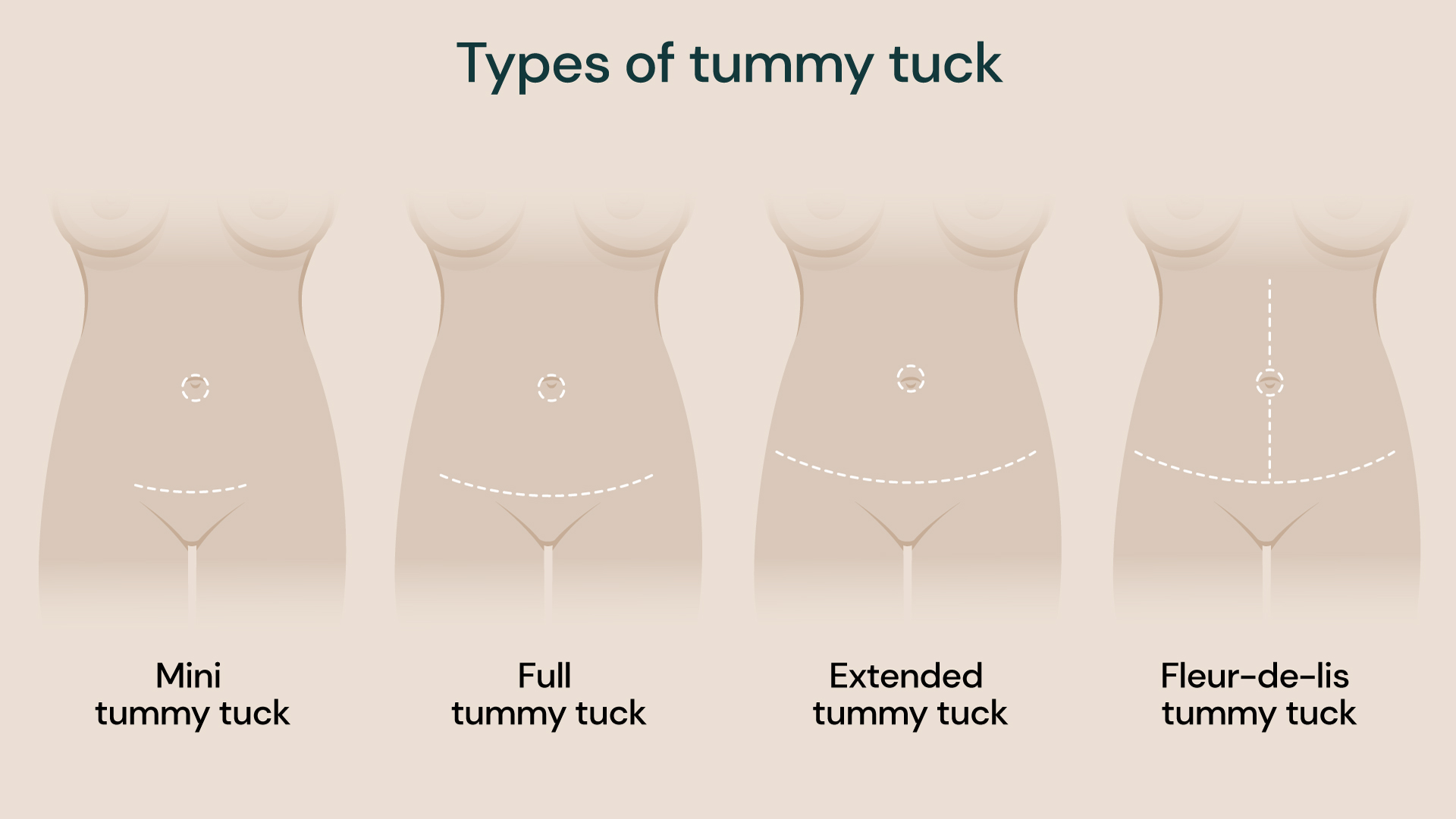
This diagram shows the different types of tummy tuck (abdominoplasty) procedures. Options include mini, full, extended and fleur‑de‑lis tummy tucks, each varying in incision length and the amount of excess skin removed.
Mini (partial) tummy tuck
In a mini tummy tuck, our plastic surgeons will make a smaller incision in your lower abdomen than for a full tummy tuck.
This procedure is usually recommended if you have a smaller amount of excess skin and fat, mainly below the belly button. It is less suitable for patients with more significant loose skin above the belly button or marked separation of the abdominal muscles
Unlike a full tummy tuck, your belly button will not be moved, so it may take on a slightly different shape after the procedure.
Full (standard) tummy tuck
In a full tummy tuck, our plastic surgeons will make an incision across your lower abdomen from one hip to another.
This procedure addresses loose, sagging skin and fat that is common with older age, pregnancy and weight loss. It also tightens weakened and separated muscles above and below the belly button, creating a smoother and firmer abdominal profile.
An incision is also made around the belly button since this needs to be moved when skin is removed, for a natural look.
You will have a scar around your belly button and a long-curved scar above your pubic area. The scar is usually higher in men than for women, due to the normal pattern of pubic hair. Due to their position, these scars are usually hidden by underwear or swimwear.
Extended tummy tuck
An extended tummy tuck is similar to a full tummy tuck, but the incision usually extends further around the sides of your body.
This type of procedure may be recommended if you have excess skin around your sides or lower back, in addition to the front of your abdomen. This is is often seen after significant weight loss.
You will usually have a scar around your belly button and a longer scar across your lower abdomen that extends towards your sides.
Fleur-de-lis tummy tuck
A fleur-de-lis tummy tuck may be recommended if you have a large amount of excess skin across and down your abdomen, which is often seen after significant weight loss. The procedure removes loose skin in both directions.
You will have a scar across your lower abdomen as well as a vertical scar down the centre of your abdomen. You will also usually have a scar around your belly button.
This procedure can help achieve a greater improvement in your body shape, but it does result in more visible scarring. Our consultants will discuss all surgical options to help choose an approach that’s best for you.
Who is suitable for a tummy tuck?
A tummy tuck (when combined with liposuction) removes excess skin and some of the fat just beneath the skin of your abdomen. It does not remove fat under your abdominal muscles and around your organs, which may be present if you are overweight.
For this reason, a tummy tuck is not recommended for losing weight, but is good for removing excess skin and reshaping your abdomen.
If you would like to speak to one of our plastic surgery specialists about the different types of tummy tuck procedure and your suitability, please contact our team to arrange an appointment.
Preparing for a tummy tuck
Before having a tummy tuck, you will have a consultation with one of our plastic surgeons. During the consultation, they will ask about your health, any medications you take and your family history. They will also examine your abdomen to ensure you’re a suitable candidate for the surgery.
During your consultation, our plastic surgeons will discuss any specific preparations you need to make for your tummy tuck. They will also usually take clinical photographs that are stored on your medical record as well as confirming your weight and BMI.
What happens during a tummy tuck?
We perform our tummy tucks under general anaesthetic.
In a mini tummy tuck, our plastic surgeon will:
- make an incision across your lower abdomen
- separate the skin from your abdominal wall, just below your belly button
- remove excess skin and fat
- close the area by pulling the skin together and stitching it in place
In a full tummy tuck, our plastic surgeon will:
- make a larger incision from one hip to the other above your pubic area
- make a second incision to separate your belly button from its surrounding tissue
- separate the skin from your abdominal wall
- remove excess fat and skin
- if there is a gap in your muscles (usually after pregnancy) they will repair it
- cut a new hole for your belly button in your abdomen and stitch it
- pull together and stitch the remaining skin
How long does a tummy tuck take?
A tummy tuck takes between 2 and 5 hours to complete and will vary depending on the type of tummy tuck you have and the procedure’s complexity.
Tummy tuck recovery
After your tummy tuck, we’ll take you to the recovery room and provide pain relief medication. You will need to stay in hospital for 1 night so that we can monitor your initial recovery.
When we discharge you, you must have someone drive you home and stay with you for 24 hours. We’ll provide a compression garment, which you must wear for 6 weeks. It helps to minimise swelling and promote healing.
Most people are able to return to many normal day-to-day activities within 4 to 6 weeks, although this varies depending on the type of tummy tuck and the extent of surgery. Swelling and tightness can take several months to settle, and scars usually continue to mature and fade over 12 to 18 months.
During your recovery, you’ll attend a follow-up appointment where our plastic surgeon will assess your healing and discuss when it’s safe to resume your usual activities.
What is the recovery time for a tummy tuck?
It usually takes 6 weeks to recover from your tummy tuck to the level where you are doing all your normal activities. Although you will see a huge improvement straight away it can also take up to 6 months to see the full effect of your treatment.
Benefits of a tummy tuck
A tummy tuck can provide many benefits, including:
- strengthened abdominal muscles
- reduced risk of skin infections in any folds of abdominal skin
- enhanced, toned abdominal appearance
- boosted self-esteem if you’re unhappy with your current appearance
Risks of a tummy tuck
Most tummy tuck procedures are successful and without complication.
However, all surgical procedures carry risks. The possible risks of a tummy tuck can include:
- scarring from your incisions (scars will fade over time)
- pain
- bruising
- numbness in your abdomen (this improves over months)
- fluid-filled swelling around your scar (called a seroma)
- infection
- asymmetry
- delayed healing
- wound breakdown
- failure of muscle repair
- deep vein thrombosis
If you would like to speak to one of our plastic surgeons about the benefits and potential risks of a tummy tuck procedure, contact our team to arrange a consultation at a time that suits you.
Costs of a tummy tuck
The cost of a tummy tuck will depend on the exact procedure you are having. We can give you an estimate, but the exact cost will be sent following an assessment by our plastic surgeons.
Learn more about paying for your care or contact our team to discuss our tummy tuck pricing.
Reviewed regularly to reflect clinical best practice
Last reviewed: 19 June 2026
Locations
Tummy tuck (abdominoplasty) is available in the following location:
Meet our team of plastic surgeons
Our highly skilled plastic surgeons provide desired tummy tuck results based on your needs. We are committed to providing you with the highest standard of care and excellent results.