

Content verified by

What is pyeloplasty?
Pyeloplasty is a surgery to treat blockages between your child’s kidney and ureter, the tubes that carry urine to the bladder. When this junction becomes blocked urine starts to accumulate inside the kidney and stops draining properly. This can lead to discomfort, pain and other complications like kidney swelling, called hydronephrosis, and kidney damage.
The blockages typically occur when urine leaves the kidney at the body’s ureteropelvic junction (UPJ) and moves down to the bladder. Sometimes an abnormal blood vessel, can cause a blockage by pressing on the UPJ, which stops urine’s journey to the bladder. A pyeloplasty aims to improve the urine flow from the kidneys to the bladder.
Our experienced paediatric urologists perform pyeloplasty at Evelina London Children’s Hospital as part of our children’s urology service. Your child will receive specialist assessment and dedicated treatment for kidney and urinary tract conditions.
Experts in treating children’s urological conditions
Our specialists at Evelina London Children’s Hospital offer personalised care, including:
- short notice appointments
- fast and accurate diagnosis
- treatment appointments in as little as 1 week

Why might pyeloplasty be performed?
Your child might need a pyeloplasty if their ureter becomes blocked. This blockage usually occurs at birth but can also develop in older children.
If your child’s ureter stays blocked, it can lead to stretching of the kidney and damage. It can also make your child more prone to urinary infection. Pyeloplasty surgery helps to prevent these complications.
Who is suitable for a pyeloplasty?
We perform pyeloplasty in children with a blocked ureter. The blockage is confirmed by specialist tests like ultrasound scans and nuclear medicine scans. If your child has a blockage, we’ll discuss their treatment options during a full consultation.
To learn more about whether your child is suitable for a pyeloplasty, contact our customer services team to arrange a consultation.
Preparing for pyeloplasty
Before your child’s pyeloplasty, we’ll inform you of any specific preparations they must follow.
Your child must stop eating and drinking a set number of hours before their appointment, as we perform a pyeloplasty under general anaesthetic. We’ll give your further details about this in advance of the procedure.
We’ll also discuss pain relief options suitable for your child’s needs so you can ensure they’re comfortable once they return home.
Our supportive team will fully inform you what to expect before, during and after your child’s pyeloplasty.
What happens during a pyeloplasty?
We’ll administer the general anaesthetic once your child is ready. It will put them in a sleep-like state during the procedure.
How is a pyeloplasty performed?
We can perform a pyeloplasty as laparoscopic (keyhole) or open surgery. We’ll confirm which is best for your child’s needs during their pre-operative consultation.
Open pyeloplasty
In an open pyeloplasty, the surgeon makes one large incision in your child’s abdomen to remove and repair the blocked ureter.
Laparoscopic (keyhole) pyeloplasty
In laparoscopic pyeloplasty, they make small incisions in the abdomen. The surgeon will insert a special tool with a camera on one end (called a laparoscope) into one of the incisions and surgical tools into the others. They’ll use carbon dioxide gas to inflate your child’s abdomen, making it easier for the camera to pick up clear images.
Robotic-assisted pyeloplasty
In robotic-assisted pyeloplasty, the surgeon uses the Versius Surgical Robotic System to carry out the operation minimally invasively. The robot has flexible modular arms which operate miniaturised surgical instruments, with one arm controlling a 3D camera that allows the surgeon to see inside the patient.
This approach enables a very precise operation and placement of sutures for our young patients.
Once they have the tools and laparoscope in place, the surgeon will repair the blockage in your child’s ureter. They do so by locating the blockage, removing the affected section and rejoining the ureter.
Using a ureteric stent
The surgeon may insert a stent into the ureter to keep it open while healing. We must remove the stent between 1 and 6 weeks after their pyeloplasty. We perform this short procedure under general anaesthetic. We’ll tell you when your child must return for the stent removal.
Most children will also have a urinary catheter placed in the urinary bladder for 1-2 nights, which is removed before the child is allowed to go home.
When the surgeon places the stent, they will remove the tools and laparoscope and stitch the incisions. We usually use dissolvable stitches so your child won’t need to return to have them removed.
Your child will then be taken to the recovery area, where our team will monitor them as they wake up from the anaesthetic.
If you have any questions about pyeloplasty or your child’s treatment, please contact our team, who will be happy to provide advice and support.
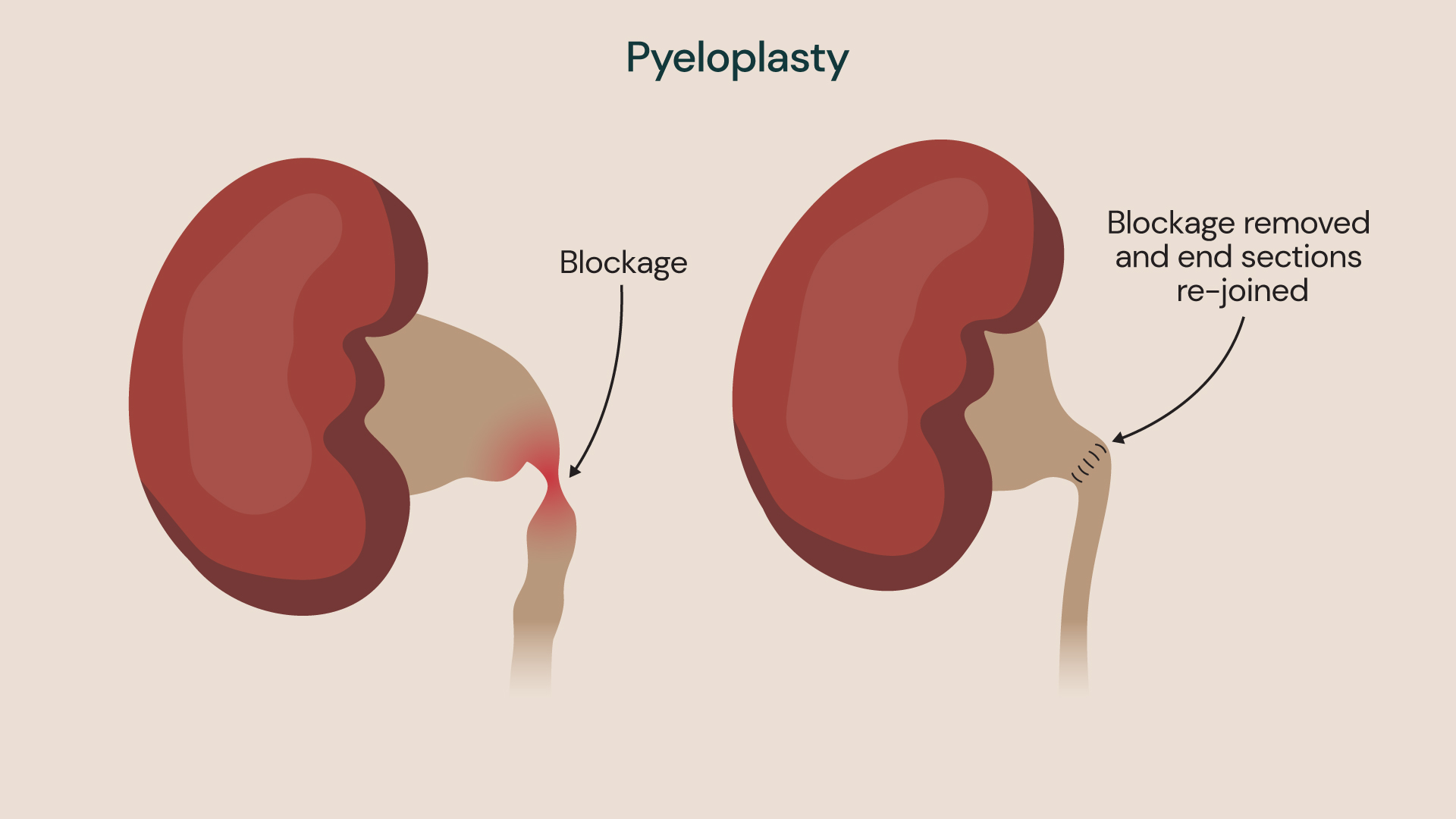
Diagram illustrating pyeloplasty surgery, where a blockage between the kidney and ureter is removed and the healthy ends are reconnected to restore urine flow.
How long does a pyeloplasty take?
A pyeloplasty can take up to 2-3 hours to complete.
What happens after a pyeloplasty?
Your child will come round from the anaesthetic in the recovery room. They might feel groggy or nauseous at first. They can eat and drink as soon as they feel able to. Your child may need to stay in the hospital for up to 2 days.
Post-operative care of your child depends on the type of urinary stent our specialists need to use. The 2 most common types of stents used across the suture line are an external stent which drips into the nappy, or an internal stent which is entirely inside the body. An internal stent requires subsequent removal by a camera passed through the urinary passage in a separate procedure.
We’ll provide personalised aftercare advice for your child so you can help them recover entirely at home.
What is the recovery time for pyeloplasty?
It’s typical for your child to feel discomfort for the first day or 2 after their operation. Over-the-counter pain relief medications should be enough to provide relief.
They can move normally with the tube in, but they may feel tired from the procedure and not be as active as usual. We often recommend keeping them home from school for about 1-2 weeks.
Your child’s urine may look slightly pink or red due to small amounts of blood. Encouraging them to drink plenty of fluids can help flush the blood out.
It can take a few weeks for your child to return to normal.
Book a consultation with one of our paediatric specialists to find out more about the procedure and recovery process. Contact our team to make an appointment.
Benefits of pyeloplasty
A pyeloplasty can benefit your child’s overall health and wellbeing. Not only will it treat their immediate symptoms, but it will also prevent them from worsening or returning in the future, and will avoid further kidney damage.
Risks of pyeloplasty
Possible risks of a pyeloplasty include:
- bleeding during the operation
- urine leaking from the rejoined ureter
- infection
- reactions to the general anaesthetic (rare)
All surgeries have potential risks. However, our paediatric urologists will do everything possible to minimise complications and risks.
Reviewed regularly to reflect clinical best practice
Last reviewed: 23 September 2026
Locations
Our children's urology services are offered at:
Meet our children’s urology specialists