
Content verified by

What are undescended testicles (cryptorchidism)?
Undescended testicles (cryptorchidism) is a common condition present from birth, where one or both testicles have not moved into the scrotum as expected. During development, the testicles form in the abdomen and usually descend into the scrotum before birth. In some babies, this process does not complete, and the testicle may remain in the groin or abdomen.
If the testicles have not descended by around three months of age, specialist assessment is recommended. In many cases, the testicle can be felt in the groin and treated with a straightforward surgical procedure to move it into the scrotum. Where the testicle cannot be felt, minimally invasive (keyhole) surgery may be used to locate it within the abdomen. Some children may require staged procedures to achieve the best outcome.
At Evelina London Children’s Hospital, our specialists provide expert assessment and treatment for undescended testicles as part of our children’s urology service.
Experts in children's urology
Fast access to specialist paediatric urology care you can trust, including:
- short-notice appointments, often within 24 hours
- fast, accurate diagnosis from specialist clinicians
- rapid access to treatment, typically within one week

Undescended testicles symptoms
It’s estimated that around 1 in every 25 boys is born with at least one undescended testicle. In many cases, there’s no need for treatment, as the testicles will descend naturally within the first three months after a baby is born.
An undescended testicle is usually detected by not seeing or feeling a testicle where it should be in the scrotum. It doesn’t tend to cause any other noticeable symptoms.
For this reason, most cases are detected shortly after birth when your baby is given a physical examination.
How to check for undescended testicles
The best way to check for an undescended testicle is with a physical examination. Your doctor should be able to gently palpate (examine by touch) the scrotum to feel the testicle inside.
If this is missing, or there are any unusual swellings that don’t feel right, it’s a good idea to get it checked by a specialist.
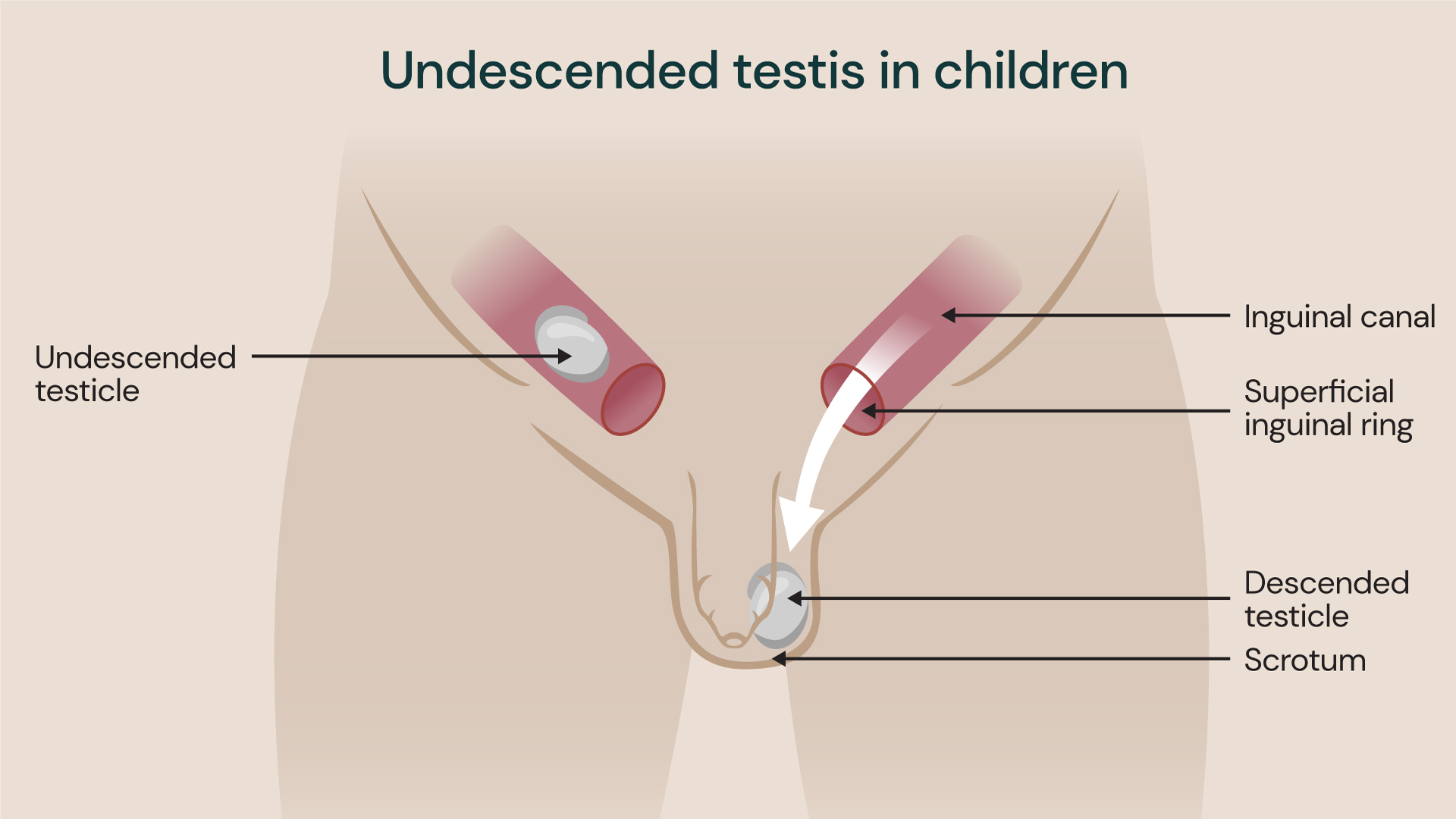
An undescended testicle is usually detected by not seeing or feeling a testicle where it should be in the scrotum.
What causes undescended testicles?
So, what causes undescended testicles (also known as cryptorchidism)? Unfortunately, in most cases, it’s not known why some children are born with undescended testicles and others aren’t.
However, research has shown that babies who are born prematurely (before 37 weeks gestation) are more likely to be affected.
Complications of cryptorchidism
Children who have undescended testicles and don’t have treatment are at greater risk of experiencing several complications. One of these is fertility problems. This is because undescended testicles that aren’t brought into the scrotum at a young age may not produce good sperms.
Undescended testicles have also been associated with an increased risk of testicular cancer. In fact, people with undescended testicles are three times more likely to develop testicular cancer than those whose testicles descended either at birth or shortly after. Unfortunately if diagnosis of pathology (like cancer) is often delayed if the testis are not in the scrotum as they are not easy to feel.
Some children have what is known as a retractile testicle. This is where the testicle moves back and forth between the scrotum and groin and occurs due to a muscle reflex. This is fairly normal and over time, the testicles should settle into a permanent position in the scrotum.
Hypospadias and cryptorchidism
Some studies have suggested that undescended testicles, alongside a condition called hypospadias, are signs of something known as testicular dysgenesis syndrome — a health concern that can impair fertility.
Hypospadias is a birth defect in which the opening of the urethra isn’t located at the tip of the penis. Instead, it is usually found on the underside of the penis, or occasionally between the anus and scrotum. Again, this is a problem that occurs during fetal development and isn’t usually detected until the baby is born.
Diagnosis of undescended testicles
If your child’s testicles have not descended by around three months of age, they will usually be referred to a specialist for assessment. In most cases, the testicle can be felt in the groin during a physical examination, which helps guide the next steps in treatment.
If the testicle cannot be felt, further investigation may be needed. This can include minimally invasive (keyhole) surgery, known as laparoscopy, to locate the testicle within the abdomen and assess the best approach for treatment.
Undescended testicle treatment
Surgery is the standard treatment for undescended testicles and is usually recommended before your child reaches 12 months of age. Early treatment can help reduce the risk of future fertility problems and supports early detection of any potential testicular issues later in life.
For testicles located in the groin, a straightforward procedure can often move the testicle into the scrotum. If the testicle is within the abdomen, laparoscopic surgery may be required, and in some cases, treatment may be carried out in two stages to achieve the best outcome.
All procedures are performed under general anaesthetic, meaning your child will be asleep during surgery. Recovery is typically quick, with most children returning to normal activities soon after, provided post-operative guidance is followed.
Children’s urology at Guy’s and St Thomas’ Specialist Care
Our paediatric urology specialists provide expert diagnosis and surgical treatment for undescended testicles, ensuring safe, effective care tailored to your child’s needs.
Contact our team to arrange an appointment.
Reviewed regularly to reflect clinical best practice
Last reviewed: 02 February 2024
Locations
Our specialists offer treatment for undescended testicles at the following location:
Discover our undescended testicles experts
Meet our team of paediatric urologists. From bladder health to advanced kidney interventions, our specialists are here to provide you with personalised care.