

Content verified by

What is trigger finger?
Trigger finger affects the way your thumb or fingers bend and straighten. The problem occurs if the tendon in your child’s hand that controls the bending of their finger or thumb can’t glide smoothly in its tendon sheath (the ‘tunnel’ it runs through).
This may happen if the tendon becomes swollen or inflamed, or if a small lump forms (called a nodule). The tendon will get caught in the tendon sheath it runs through and as a result, your child may find it difficult to move their finger or thumb, as well as feel pain.
If symptoms are mild, we may recommend pain relieving medications like ibuprofen. If pain is more severe, steroid injections may be given to minimise swelling of the tendon sheath. In cases where these treatments do not work, our consultants may recommend trigger finger surgery.
Our world-renowned children’s plastic surgeons at Evelina London Children’s Hospital are experts at treating trigger finger. We provide personalised care to achieve the best results for your child.
Experts in treating trigger finger
Our world-class paediatric consultants offer:
- short-notice appointments
- specialist expertise in trigger finger surgery
- fast access to treatment

Trigger finger symptoms in children
Trigger finger can affect the thumb or any of your child’s fingers, including multiple fingers at once, and might occur in both hands.
Some children do not experience noticeable trigger finger symptoms. However, some may complain of pain in the base of the affected finger or thumb. Their finger or thumb may also struggle to bend or straighten completely.
Sometimes, you can hear a clicking noise when they move the affected finger or thumb. A lump can develop in their palm, or their finger may get stuck in a bent position. The affected finger might bend, but lock into position before ‘popping’ back straight.
As some children do not develop painful symptoms, you must watch how their fingers and thumb bend. It could be trigger finger if they struggle with these types of movements.
What causes trigger finger in children?
When the tendon sheath in your child’s hand becomes swollen or inflamed, this is what causes trigger finger and leads the tendon sheath to narrow. This then stops the tendon from moving through the sheath easily, increasing its likelihood of getting stuck. If your child’s trigger finger is causing pain, or finger or thumb restrictions, treatment is normally recommended.
If your child is experiencing a finger that catches, locks or is difficult to straighten, get in touch with our team for specialist advice and assessment.
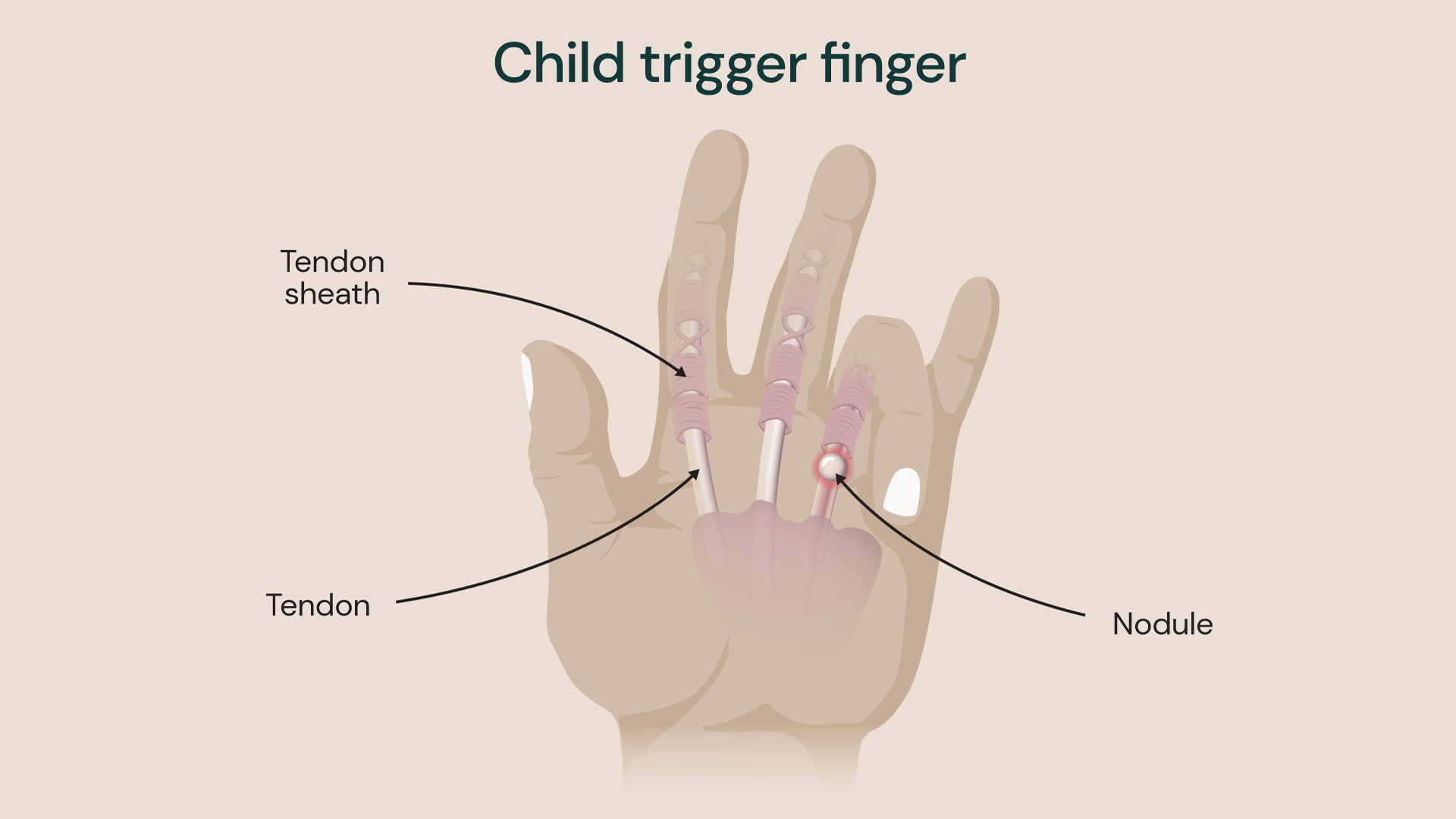
Trigger finger occurs when the tendon controlling a finger or thumb can’t glide smoothly in its tendon sheath.
Who is at risk of trigger finger?
Trigger finger is a relatively common hand condition in young children and most often develops between the ages of 1 and 3 years old. The condition can be congenital (present at birth) or appear as your child develops. No one knows the risk factors of trigger finger. However, certain children may be more at risk if they have previously had a hand injury.
In some cases, it can get better on its own without treatment, especially in very young children. If the condition doesn’t resolve by itself, our consultants may recommend surgery.
Complications of trigger finger in children
If your child’s trigger finger is not treated and it doesn’t improve as they grow, this may lead to:
- pain in their palm or affected finger or thumb
- finger or thumb deformities
- reduced motion and dexterity
- problems with their fine motor skills
Early assessment can help you understand the best treatment options for your child. Get in touch to find out more.
Diagnosing trigger finger in children
Various examinations and tests can help to diagnose trigger finger in children. First, a doctor will physically examine your child’s hand and ask them to try and move their fingers and thumb.
Sometimes, further imaging tests may be necessary, such as an X-ray or ultrasound scan. However, a physical examination is usually enough to diagnose a trigger finger.
If you have noticed a lump at the base of your child’s finger or changes in finger movement, get in touch for expert guidance.
Treating trigger finger in children
We may recommend at-home care if we diagnose trigger finger in your child and their symptoms are mild. Non-steroidal anti-inflammatory drugs (NSAIDs) like ibuprofen may help to relieve pain. We might also use steroid injections if their pain is more severe to minimise the swelling of the tendon sheath.
Sometimes, we may strap their fingers to a plastic splint to reduce movement while the inflamed tendon’s swelling heals.
However, we may recommend surgery if none of these treatments help your child’s trigger finger. We perform our paediatric trigger finger surgery at our Children’s Day Surgery Unit at Evelina London, which is one of the world’s best children’s hospitals.
Trigger finger surgery
We perform surgery for trigger finger under general anaesthetic, so your child will be asleep throughout and will not feel any pain. Our paediatric surgeon will instruct you on any specific preparations you will need to follow for your child, such as needing to fast before their appointment.
Once the anaesthetic has taken effect, our surgeon will make a tiny cut into the affected hand. Next, they will gently cut the tendon sheath surrounding the affected tendon to release it – giving the procedure its name, ‘trigger finger release surgery’. Finally, they will close the incision with stitches and cover it with a bandage.
Generally, trigger finger release surgery takes up to 30 minutes.
Following the procedure, we’ll take your child to the recovery room, where they will wake up from the anaesthetic and be monitored throughout their initial stages of recovery. It’s typical for your child to feel drowsy or groggy afterwards and they may be confused. However, we’ll be there to reassure them that everything is OK.
Helping your child recover at home after surgery
We’ll provide all the aftercare advice you need to support your child’s recovery at home. Pain relief medication can help and we will confirm which over-the-counter medicines you can give your child. You should also elevate their hand with pillows to help minimise potential swelling.
After 1 week, your child’s bandage will need changing at the hospital. They may also need to wear a splint for between 2 and 6 weeks, which will keep their hand from moving to help it heal. We will tell you if their stitches need removing at the hospital or if they will dissolve by themselves while recovering at home.
Speak to our specialists about your child’s trigger finger
If your child is experiencing a finger that catches, locks or does not straighten normally, our specialist team is here to help.
Get in touch to discuss your concerns, learn more about your treatment options and arrange an assessment.
Reviewed regularly to reflect clinical best practice
Last reviewed: 02 July 2026
Locations
Our children's plastic surgery service is available at the following locations:
Meet our children's plastic surgery specialists