
Content verified by



What are fibroids?
Fibroids, also known as myomas or leiomyomas, are common growths that develop in or around your uterus (womb).
Around 40% to 80% of women have fibroids, however many won’t experience any symptoms. Our women’s health specialists can provide expert diagnosis and recommend the best treatment for you based on your health and the severity of your condition.
Based at St Thomas’ Hospital and Wimpole Street Consulting Rooms and Diagnostic Centre our leading gynaecology specialists diagnose and treatment for fibroids using the latest techniques.
Experts in women's health
Our gynaecologists are experts in treating a broad range of women’s health conditions, including fibroids. We offer:
- appointments in as little as 1 week
- quick access to scans and diagnostics
- fast access to personalised treatments

Types of fibroids
Fibroids frequently develop in women between the ages of 30 and 50 and are less common in those who have entered menopause, or girls who haven’t had a period yet.
Fibroids are growths consisting of muscle and fibrous tissue. They are benign (non-cancerous) and rarely turn into cancer.
You can have a single fibroid or several. Fibroids can also vary in size – some are too small to see, while others can grow to the size of a grapefruit or even a watermelon.
A substantial fibroid can change the shape of your uterus and grow large enough to fill the pelvis or stomach area, making you look pregnant.
There are 4 different uterine fibroids, named for their location and how they attach to your uterus. They include:
- intramural fibroids (the most common), which embed into the muscular wall of the uterus
- submucosal fibroids, which grow under the inner lining of your uterus
- subserosal fibroids, which grow under the outer surface lining of your uterus
- pedunculated fibroids (the rarest), which attach to your uterus with a stalk
What are the symptoms of fibroids?
Some women (1 in 3) with fibroids will experience uncomfortable symptoms, including painful, heavy and irregular vaginal bleeding, while other women find that the growths don’t affect them at all.
Symptoms depend on the fibroids’ location, size and numbers. Generally, the larger the fibroid, the more likely it is to cause symptoms.
You may experience the following symptoms if you have fibroids:
- a frequent need to pee
- a pressure or bloated feeling in your lower tummy
- a swollen tummy, which makes you look pregnant
- bleeding between periods
- constipation
- difficulty peeing or completely emptying your bladder
- heavy, long or painful periods
- lower back pain
- pain or discomfort during sex
- tummy (abdominal) pain
If you’re experiencing symptoms of fibroids, contact us and our team will help you understand what to do next.
In most cases, fibroids don’t cause complications. However, the most common complications are:
- excessive bleeding
- frequent urinary tract infections (UTIs)
- iron deficiency anaemia
- unmanageable pain
Rarely, fibroids can transform into a cancerous growth. This leads to the sudden onset of bleeding or swelling, or abrupt worsening of existing symptoms. It can also be suspected on ultrasound and MRI scans.
Can fibroids cause infertility?
Less common complications include reduced fertility and pregnancy complications. Our fertility and maternity teams can support you if you have fibroids and are currently pregnant, or if you are having difficulty getting pregnant.
Worried your symptoms may be linked to fertility? Contact our dedicated team for advice.
What causes fibroids?
Experts don’t fully understand why fibroids develop. However, studies have found that fibroids often develop and grow when oestrogen and progesterone hormone levels rise, such as during pregnancy, and become smaller when levels are low, like during menopause.
Other factors that may increase your risk of developing fibroids include:
- a family history of fibroids
- being overweight or obese
- late menopause
- not having children
- starting your period at a young age
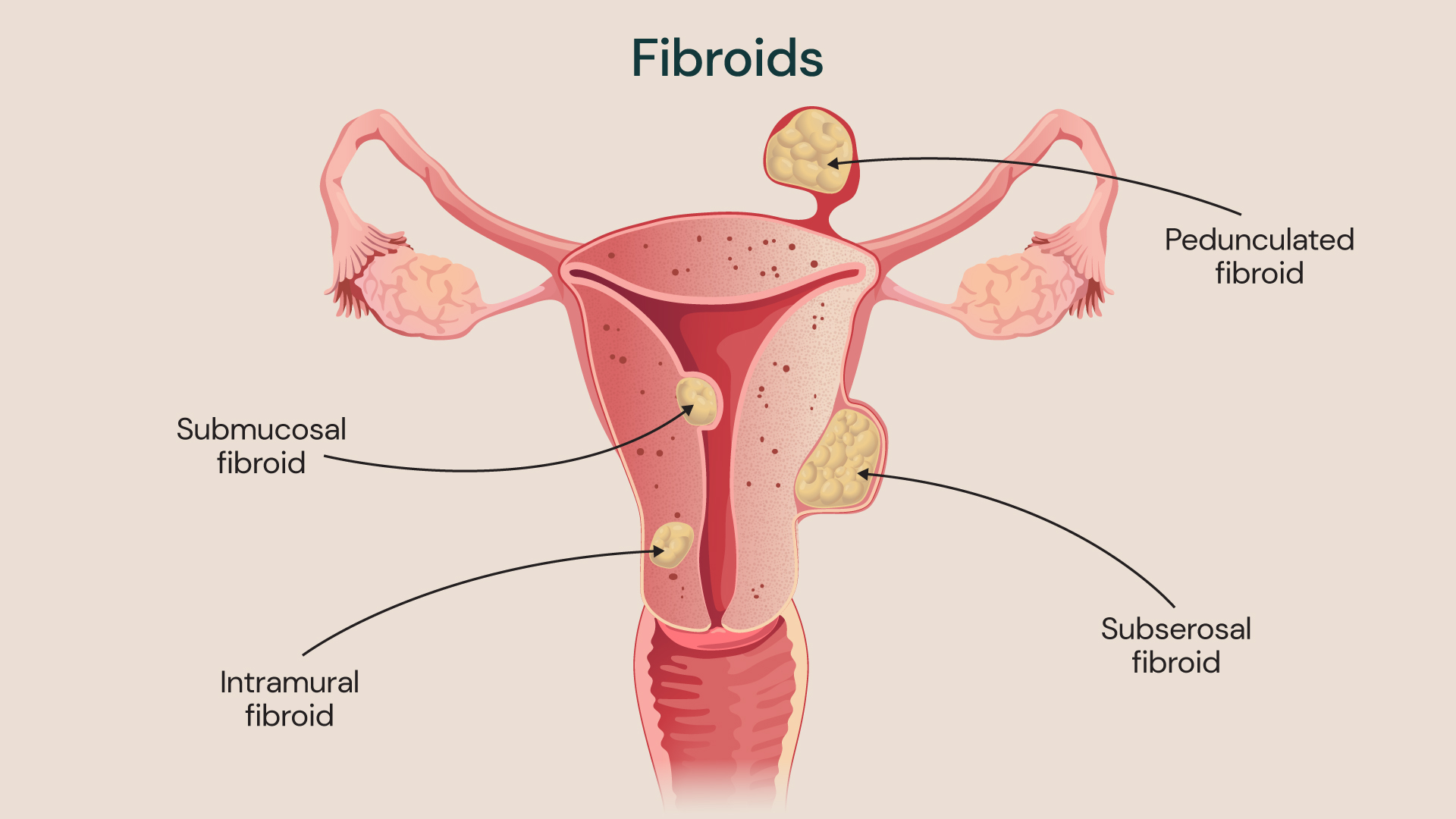
Fibroids can occur in the walls, lining, or outer surface of the uterus, and occasionally in the cervix, or attached by a stalk to surrounding pelvic structures.
Diagnosing fibroids
As most fibroids do not cause symptoms, in many cases they are usually found by chance during a routine pelvic exam, MRI or ultrasound scans leading to diagnosis.
If you do have fibroid symptoms, your specialist will recommend you first have a pelvic examination to detect any obvious signs.
Ultrasound scans
An ultrasound scan will give your consultant a detailed image of the inside of your body. The scan produces images in real-time on a screen, where your doctor can see your uterus and any fibroids.
There are 2 types of ultrasound scans that you may require for your consultant to make a fibroid diagnosis:
- an abdominal ultrasound scan where the operator pulls an ultrasound probe gently across your tummy
- a transvaginal ultrasound scan where the operator inserts a long, thin ultrasound probe into your vagina
MRI scans
An MRI scan may be required if the fibroids are too large, or if there are too many to be fully evaluated by ultrasound scan. Additionally, if our specialists have suspicions about abnormal cells, an MRI scan can provide a more detailed examination of the fibroids.
Hysteroscopy
If the ultrasound scan shows you have fibroids, you may need a procedure to examine the inside of your uterus further. This will be a hysteroscopy.
A hysteroscopy involves inserting a small telescope (hysteroscope) through your vagina and cervix into your womb. The scope allows your doctor to look at your uterus and any fibroids in detail. Sometimes, they may do a biopsy to examine a small piece of fibroid tissue under a microscope.
Need support understanding possible tests for fibroids? Contact us and we can help.
Treating fibroids
Many women may experience mild, or no symptoms of fibroids in which case no treatment is needed.
If your fibroids do require treatment, our women’s health specialists will discuss your diagnosis and recommend the best treatment for you based on your health and the severity of your condition.
The treatment you need will depend on your symptoms and the size, number and location of the fibroid(s).
Our expert gynaecologists may offer the following fibroid treatments:
- medicines to ease heavy periods and reduce period pain
- medicines to shrink the fibroids
- surgery to remove the fibroids (myomectomy) or to remove your womb entirely (hysterectomy)
- procedures to shrink your fibroids (Radio frequency ablation)
Fibroids and menopause
Most fibroids will also stop growing or shrink after menopause, which will usually help to ease symptoms or stop them completely. However, hormone replacement therapy (HRT), a treatment often used to treat menopause symptoms, can contribute to fibroid symptoms in some cases.
If you’re ready to discuss treatment for fibroids, contact our team and we’ll help you take the next step.
Reviewed regularly to reflect clinical best practice
Last reviewed: 30 January 2026
Locations
Our specialists can offer treatment for fibroids at the following locations:
Discover our fibroids experts
Meet our team of leading gynaecologists. From reproductive health to advanced interventions, our specialists provide personalised care tailored to your needs.