
Content verified by
What is a mole check?
A mole check, also known as a mole assessment, is a skin examination that is carried out by our consultant dermatologists to look at your moles in detail and identify any concerning features that may require further investigation.
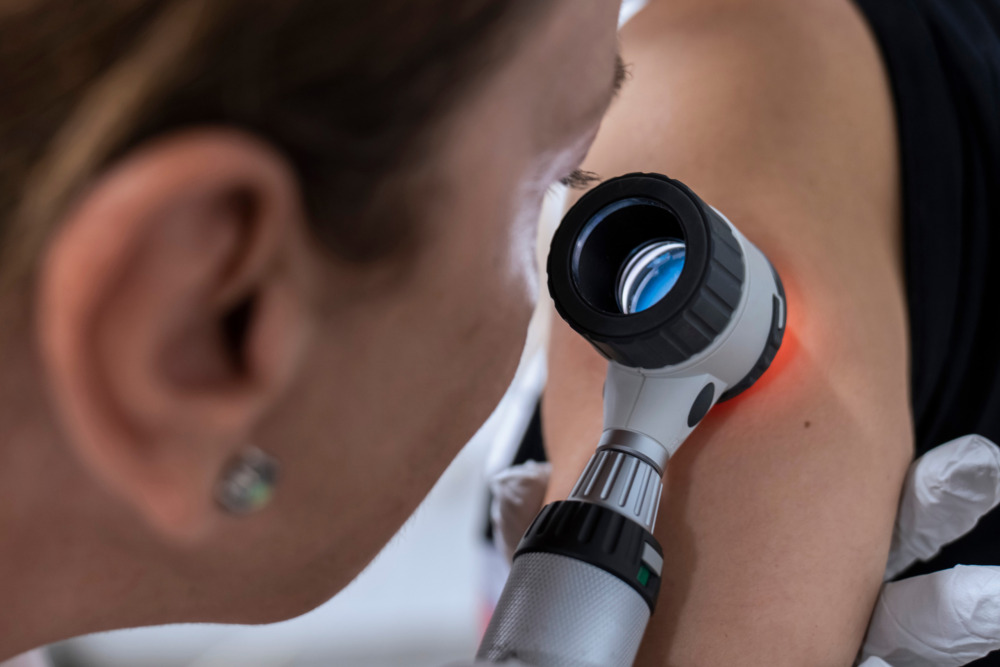
During your appointment, our specialists will use a dermatoscope, which is a handheld device that magnifies your skin to examine your mole in more detail. Following the assessment, they will confirm whether further investigation, monitoring or treatment is needed.
In some cases, a biopsy or mole removal may need to be undertaken. In these cases, either the whole mole or a small sample of tissue is removed and examined for the presence of abnormal or cancer cells.
Our consultants at St John’s Institute of Dermatology, Guy’s Hospital, can provide fast and accurate mole checks, and biopsies if further investigation is needed.
Experts in mole checks
Our consultants offer:
- short-notice appointments
- fast and accurate assessment of moles
- mole removal, if this is needed
How common are moles?
Moles are very common. Most people have 10 to 45 moles and many of them occur before the age of 35. They can grow anywhere on your body, including your armpits, scalp, under your nails and between your fingers and toes.
Moles can be brown, tan, black, blue, red or pink, and typically take on a round or oval shape. They are often less than 6mm in diameter and can be smooth, flat, rough or raised. Moles can become darker and larger due to hormonal changes, such as during teenage years or pregnancy. They can also fade over time.
Who needs a mole check?
Melanoma skin cancer is the 5th most common type of cancer in the UK. It is also the most invasive type of skin cancer with the highest risk of death. However, if it is diagnosed early, it is usually curable with effective treatment.
While most moles are harmless, changes in a mole can sometimes be a sign of a melanoma. Melanoma may often develop as a new dark lesion which resembles a mole where there was not one present before. A mole check by one of our dermatologists can help identify changes in moles, or characterise new lesions, that may require further investigation for the presence of melanoma skin cancer.
You may benefit from a mole check if you have:
- moles that have an unusual appearance (called atypical moles)
- a large number of moles
- a family history, or personal history, of skin cancer
- fair skin that burns easily in the sun
- a history of severe sunburn
- a history of frequent sun bed use
- exposure to significant amounts of sunlight, such as if you work outdoors or spend long periods living in places with a sunny climate
- a weakened immune system
What are the signs of a cancerous mole?
Certain changes in a mole can be a sign of melanoma skin cancer. The ABCDE guide can help you spot what to look out for:
- Asymmetry (A): Half of the mole doesn’t match the other half – it is uneven in shape. Normal moles have a more even shape where both halves are similar.
- Border (B): The edges of the mole are irregular, blurry or jagged. Normal moles have smooth, regular edges.
- Colour (C): The mole has changed colour, has many colours or has an uneven colour. Normal moles have one, even colour.
- Diameter (D): The mole has grown larger than 6mm. Most normal moles are 6mm or smaller.
- Evolving (E): The mole has changed in size, shape or colour. You could also notice symptoms such as bleeding.
Cancerous moles may not always show all ABCDE signs. Sometimes, they may only show 1 or 2 unusual traits, and sometimes none at all.
If you have a mole that looks unusual, has grown in size or otherwise changes, it is always best to have it checked with one of our dermatologists. You can contact our customer care team to arrange an appointment.
What happens during a mole check?
During a mole check, our dermatologists will first discuss your medical history, including any personal or family history of skin cancer, as well as any changes in your skin that you may have noticed.
After this, our dermatologists will carefully examine your moles to identify any unusual or concerning features. They will use a specialist handheld tool called a dermatoscope, which has a powerful magnifying lens and a light that allows them to examine your skin in greater detail.
Our specialists may take photographs of any abnormal moles or skin areas, which helps identify changes over time at future appointments.
What happens after a mole check?
What happens after a mole check depends on our consultant’s findings:
Reassurance
If our consultants are satisfied that your moles are harmless (also known as benign moles), they will reassure you during your appointment and advise you on how to stay safe in the sun and what changes to look out for in future.
You can always book another appointment if you notice any changes to your moles or have concerns about new moles that you would like checked.
If you would like a benign mole removed for cosmetic reasons, our consultants can discuss the treatment options available. As a specialist dermatology centre, we can offer surgical treatment to remove the mole quickly and effectively. We offer cosmetic mole removal for both adults and children. Find out more about our mole removal service.
Monitoring
If our dermatologists don’t think a biopsy is needed but are not completely certain that your moles are harmless, they may recommend a follow-up appointment to continue monitoring them closely.
At your follow-up appointment, they will examine your moles again and may compare them to photographs taken during your previous appointment.
Biopsy
If our specialists determine that a mole requires further investigation for melanoma skin cancer, they will recommend a biopsy. This procedure involves removing some or all of a mole so that it can be examined in our laboratory. In some cases, a biopsy can be performed during the same appointment as your mole check.
Before taking a biopsy from a mole, our consultants will numb the area with local anaesthetic. This will help you feel more comfortable while they perform the procedure.
There are different types of biopsy. Our dermatologists will recommend the most appropriate option based on where the abnormal area of the mole is, the size of the abnormal area and whether there is a higher suspicion of the mole being cancerous. These include:
- shave biopsy: a small flexible razor blade or scalp is used to shave off a small area of a raised mole. The procedure doesn’t usually require stitches and will heal quickly, but you will have a small scar after
- punch biopsy: a circular tool is used to remove a small, cylindrical sample of the mole. This sample contains more tissue from deeper layers of the skin than a shave biopsy and may be recommended when more tissue is needed for diagnosis. Punch biopsies usually need 2 to 3 stitches to close the wound and may leave a small scar once healed
- excisional biopsy: the entire mole is removed, along with a margin of the surrounding skin. This biopsy is usually performed for larger moles or ones that our consultants have a higher suspicion of being cancerous, as it provides the most comprehensive tissue sample for analysis. You will need stitches after the procedure which will result in a linear scar in most cases.
The tissue sample is sent to our laboratory for analysis, where a pathologist (a specialist doctor) looks at them under a microscope to determine whether abnormal or cancerous cells are present.
How do you prepare for a mole check?
There are some things you can do ahead of your mole check appointment to help you prepare for questions that our dermatologist may ask. These include:
- make a note of changes: whether it’s the change in appearance of a mole or symptoms such as bleeding, you can take notes ahead of your appointment as a reminder to discuss them
- bring a list of medicines you take: this helps our specialists understand if any medications may be affecting your moles and also to determine the most appropriate further investigations, if needed
- your history of mole removal or melanoma: if you have had a mole removed due to it being at a higher risk of cancer or have had a melanoma in the past, this is important for our consultants to know. Please also bring any past mole biopsy reports if you have them
- don’t wear makeup or nail polish: these make it harder for our dermatologists to assess your moles
If you would like to have a mole check with one of our dermatology experts, we can help. Get in touch with our customer care team to arrange an appointment.
Getting your results after a mole biopsy
Results from a biopsy can take 1 to 2 weeks, but can sometimes take longer depending on the complexity of the analysis. Our consultants will explain the results to you at a follow-up appointment.
If the biopsy identifies abnormal or melanoma skin cancer cells, our dermatologists will discuss treatment options. You may wish to bring someone with you to the appointment for support.
Reviewed regularly to reflect clinical best practice
Last reviewed: 30 July 2026
Locations
Our mole check service is available at the following locations:
Meet our dermatologists