
Author

Mr Edmund Fitzgerald O’Connor, consultant plastic surgeon at St Thomas’ Hospital, is working to pioneer advanced surgical techniques and prosthetic technology, helping people with limb differences live more active and comfortable lives.
In partnership with an orthopaedic specialist, he leads the UK’s only multidisciplinary orthoplastics team, using osseointegration to attach the prosthesis directly to the surviving bone, which improves comfort, function and independence.
What is osseointegration?
Osseointegration, also known as “direct skeletal fixation”, was first pioneered in the 1980s during the development of dental implants. It was discovered that titanium could fuse with bone, eliminating the need for dentures. In collaboration with an orthopaedic surgeon, this concept was then adapted for larger implants that could support prosthetic limbs.
For limb replacement, osseointegration is generally performed in 1 or 2 stages. In the first stage, a titanium fixture is inserted into the bone. Over approximately 3 months, the bone grows around the fixture, creating a strong anchor for the prosthesis. In leg replacements, a second stage is often required so the implant can heal before bearing weight. During this stage, the abutment (a small titanium connector) is placed on the implant, and is passed through the skin and attached to the fixture, allowing the prosthetic limb to be connected.
Rehabilitation begins after surgery with support from a team of expert physiotherapists, prosthetists, surgeons, and rehabilitation physicians. Gentle physiotherapy is essential to maintain muscle strength and joint mobility. Following the final stage of surgery, patients start “implant training”, working with a physiotherapist to gradually increase the amount of weight placed on the implant over 12 weeks.

Who’s a suitable candidate for osseointegration?
Standard socket prostheses can be heavy, difficult to attach, cause skin irritation, and provide limited movement. Osseointegration removes the need for sockets, improving comfort and range of motion. Activity-specific prostheses are also easier to swap when required.
Senior NHS orthotist Jim Ashworth-Beaumont, lost his arm in a cycle accident and, 3 years later, had osseointegration surgery under Mr Fitzgerald O’Connor’s care. Jim explains, “I work in clinical and heavy workshop environments, so I need an arm that provides strength, safety, and dexterity. I’m doing almost everything I did before – it’s easier to use now, and I’m still running and swimming regularly.”
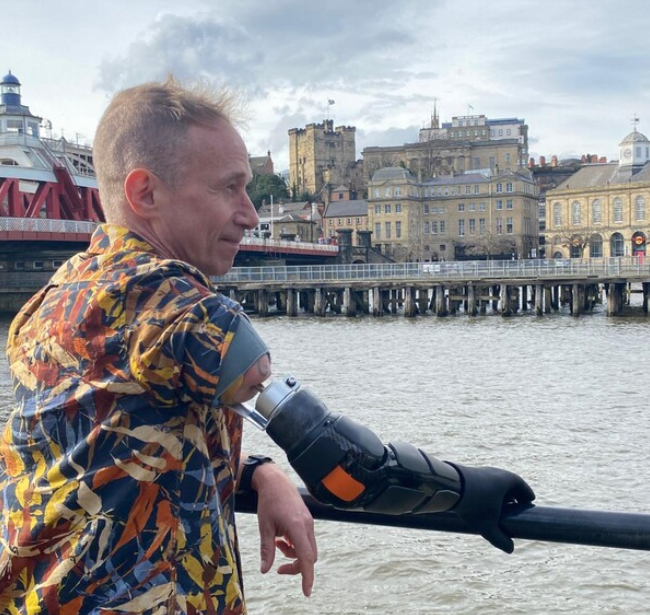
However, osseointegration is not suitable or desirable for everyone. Patients need adequate blood supply to the limb and good overall health to fully recover after surgery. There are also many different prosthetic options available.
Mr Fitzgerald O’Connor explains, “the vast majority of patients will benefit and achieve their goals with a standard prosthesis. It’s mainly in patients where functionality requirements are higher, or there have been long-term problems, that osseointegration may be appropriate.”
The safety profile of osseointegration
Osseointegration presents some risks of infection or bone fracture, but these are relatively rare and often manageable. Research shows that deep infection occurs in less than 2% of patients over 10 years. The superficial infection rate ranges from 6%–28%, but patients typically respond well to antibiotics.
Bone fractures occur in about 4.2% of all osseointegration operations (6.3% for femoral implants) and are most often caused by falls or trauma, rather than the procedure itself. Most can be treated without removing the implant.
At Guy’s and St Thomas’ Specialist Care, patients benefit from the UK’s only multidisciplinary orthoplastic team. The combined expertise of plastic and reconstructive expertise with orthopaedic specialists ensures both bone and soft tissue are managed to the highest standard, helping to minimise risk and improve long-term outcomes. The team has trained internationally with world leaders in osseointegration to bring the latest surgical techniques to the UK.
The future of osseointegration
Advances in prosthetic robotics are creating new possibilities. Improvements in dexterity, strength, and sensory feedback could be harnessed via osseointegration to create prosthetic limbs that function much like natural ones.
Mr Fitzgerald O’Connor says, “we’re at the forefront of this technology. As it develops, it will help patients who’ve suffered catastrophic injuries return to a level of function close to their pre-injury life.”
With its potential to integrate the next generation of robotic prosthetics directly with the skeleton and, in the future, the nervous system, osseointegration could play a major role in limb replacement. This approach enables people to live more active and independent lives.
Our team has partnered with Integrum to offer the OPRA implant system. It is the only FDA-approved osseointegration system and the only one supported by more than 20 years of outcome data demonstrating its success.
When to refer to us
Patients struggling with their prosthesis due to discomfort or poor functionality may benefit from osseointegration. Osseointegration can be used for both arms and legs and even digits of the hand. Patients should be in good overall health with no active infections or conditions such as poorly controlled diabetes. If a patient is interested in osseointegration or experiences issues with their current prosthesis, our specialists can provide personalised advice and guidance.