
Content verified by

What is syndactyly?
Syndactyly is where your child is born with webbed fingers or toes. It means the skin or bone between the fingers or toes is fused, likely reducing function and movement. As a result, your child’s hand or foot has a webbed-like appearance.
The only way to effectively treat syndactyly is through release surgery. Your child will be given general anaesthetic, before our plastic surgeons perform the procedure to separate the fused digits. They may also apply a skin graft to cover gaps in the separated digits. Your child will be able to go home on the same day that they are treated.
Evelina London Children’s Hospital is recognised as a world-leading centre for paediatric care. Our children’s plastic surgery service offers specialist care from experts in syndactyly release surgery, providing personalised care to achieve desired results.
Experts in syndactyly release
Our world-leading consultants offer:
- short-notice appointments, available in as little as 24 hours
- specialist syndactyly release surgery
- fast access to treatment

Who is at risk of syndactyly?
Syndactyly is the second most common congenital hand condition in children. A congenital hand condition is something you’re born with.
Any baby can be born with syndactyly, but it’s more common in boys. Your child may have an elevated risk if your family has a history of genetic disorders, especially syndactyly.
Syndactyly symptoms in children
The main symptom of syndactyly is visibly fused fingers or toes.
Syndactyly can occur in 1 or both hands or feet, and affect 2 or more digits. Sometimes, other hand abnormalities like polydactyly (extra digits) are associated with it.
If your child has syndactyly of the hand and no one treats it, they can find it challenging to use their hands as they age. However, earlier treatment, particularly if the thumb or little fingers are involved, can help reduce functional issues in the future.
There are different types of syndactyly:
- simple, incomplete syndactyly – only part of the skin and soft tissues between digits is fused
- simple, complete syndactyly – the skin and soft tissues between the whole length of two digits is fused
- complex syndactyly – bone, nerves and blood vessels are fused, in addition to skin and soft tissue (this type is rare)
No matter your child’s syndactyly type, our dedicated paediatric plastic surgeons can help. If your child has syndactyly and you would like to speak to one of our paediatric plastic surgery specialists, get in touch with our team to book an appointment.
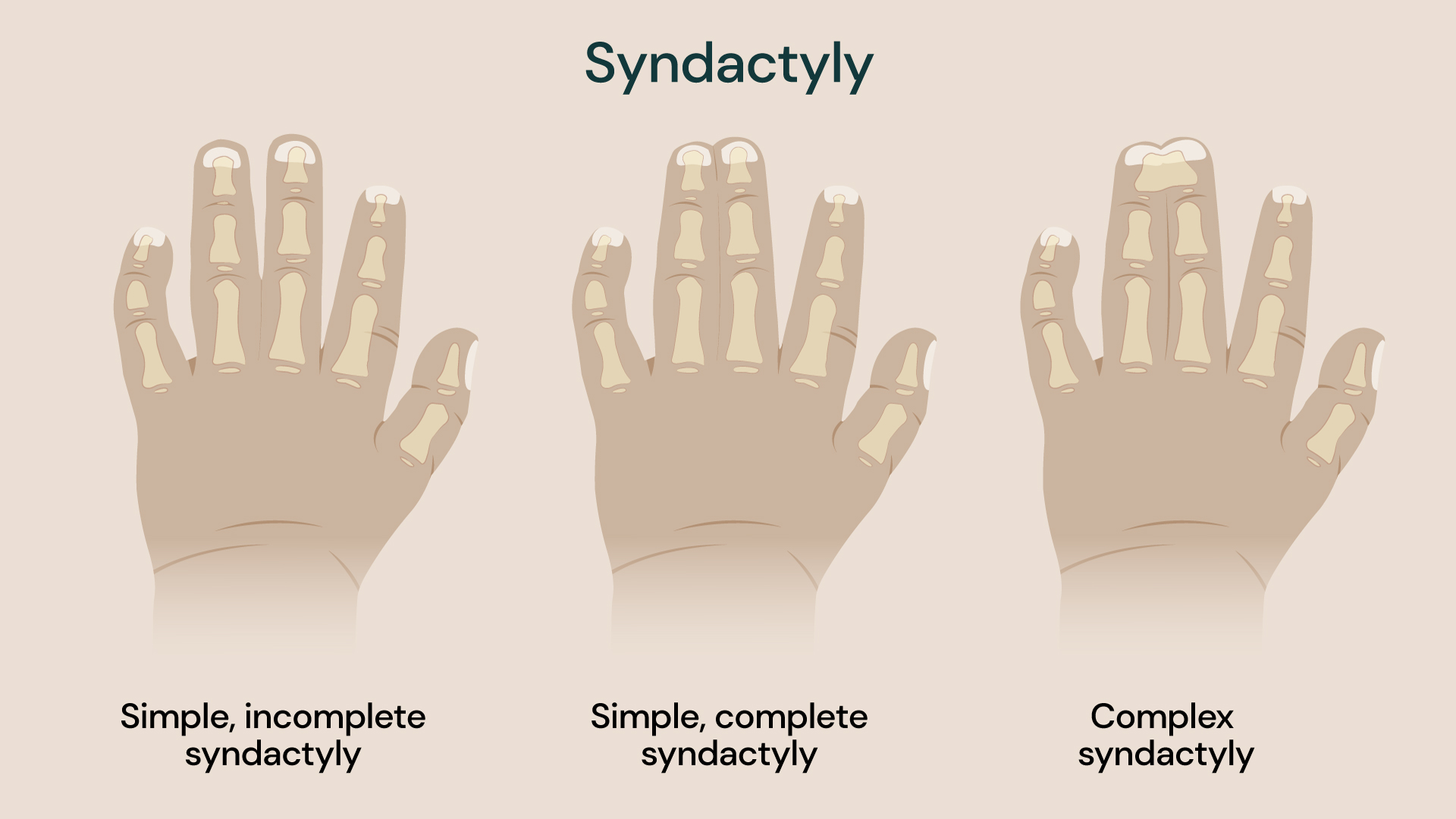
The different types of syndactyly
What causes syndactyly in children?
Syndactyly develops while your child is in the womb, and in some cases, there is thought to be a disruption to their genes.
The genes that parents pass on to their children contain instructions on how each cell must grow. However, if an interruption or a change happens to a gene, it can lead to congenital birth anomalies like syndactyly.
Genetic disorders, such as Down’s syndrome, may also be associated with syndactyly.
Experts believe syndactyly is a dominant trait. This means that children are much more likely to have it if one parent has it in their genetic make-up.
Complications of syndactyly
The complications of syndactyly depend on the severity of your child’s condition. When complex and complete syndactyly is left untreated, it can lead to functional problems later in life.
However, once treated, their hand or foot function should be unaffected, and their development will continue as usual.
Diagnosing syndactyly in children
We diagnose syndactyly, typically immediately after birth, through a physical examination of your child.
If we think your child has syndactyly, we’ll advise treatment based on how affected their hand function is or the extent of fusion between their fingers or toes.
Generally, your child requires no further testing as we can easily see and assess syndactyly. However, we may X-ray their hand or foot before treatment to create a clear image of the inside of the fusing.
Syndactyly treatment
The only way to treat syndactyly is through release surgery. Our paediatric plastic surgeons can perform it as a simple day-case procedure so that your child can go home after their treatment.
We perform our syndactyly release procedures at our Children’s Day Surgery Unit at Evelina London. It is a comfortable, child-friendly environment, so your child will feel safe and secure throughout their treatment. Find out more about private children’s same day surgery here.
We use a general anaesthetic, so your child will be asleep throughout. Once the anaesthetic has worked, we’ll separate the fused digits. Sometimes, children need a skin graft to cover the separated digits. It involves taking a section of skin from elsewhere on the body and using it to cover the gaps on their separate digits. Our plastic surgeons will advise if this is needed for your child.
After we complete the surgery, we will take your child to the recovery room, where you can see them. Once we have completed our checks and feel it is safe to do so, you can take them home to continue their recovery.
Your child might need to wear a splint or a cast on their hand or foot while it recovers. Some children also require physiotherapy to help regain strength and movement in the affected hand or foot. We’ll explain any specific aftercare guidelines you must follow once your child is at home.
Expert care for children with syndactyly
If you would like to learn more about syndactyly release surgery, our children’s plastic surgeons are here to help.
Get in touch with our team to discuss your child’s condition, explore treatment options and arrange an initial consultation.
Reviewed regularly to reflect clinical best practice
Last reviewed: 02 July 2026
Locations
Our children's plastic surgery service is located at:
Meet our paediatric plastic surgeons