
Content verified by

What is a macular hole?
A macular hole is a hole or tear in the macula of your eye – the centre part of your retina. The retina part of the eye reacts to light and enables you to see. If a hole develops in your macula, it can affect how your retina responds to light and cause changes to your vision.
A macular hole typically develops in just one eye but it can also occur in both at different times or simultaneously.
Our expert-led ophthalmologists at St Thomas’ Hospital offer accurate diagnosis and comprehensive treatment for macular holes to protect your vision. Our specialists will ensure that you receive prompt care to minimise macular hole complications.
Experts in private eye care
Our ophthalmology specialists at St Thomas’ offer personalised care to patients with eye conditions ranging from common to the most complex. We offer:
- short-notice appointments
- fast and accurate diagnosis
- fast access to treatment

Who is at risk of a macular hole?
Macular holes may be more common if you:
- are a woman
- are older than 55
- are very nearsighted (far-away objects look blurry)
- have a history of eye trauma or injury
- have had previous eye surgeries
Types of macular hole
There are 2 main types of macular holes – primary and secondary.
- Primary macular holes develop without an injury to your eye or because of a medical condition.
- Secondary macular holes are often the result of eye trauma or a medical condition.
To learn more about how our eye specialists can treat macular holes, contact our customer care team, who will be more than happy to advise.
Symptoms of a macular hole
Macular hole symptoms usually worsen when the condition remains untreated. Early symptoms include:
- blurred vision
- distorted vision
- problems reading small print
As a macular hole progresses, you may develop a dark spot or blind patch in the centre of your vision.
Seeking care as soon as possible is crucial for macular holes as this can make them easier to treat and minimise the risk of complications.
What causes a macular hole?
Macular holes can have several causes but the most common cause is vitreous traction. This happens when the jelly-like substance in your eye (vitreous humour) changes consistency and shrinks.
When this happens, it pulls on your macula and can cause a tear or hole to develop. Vitreous traction is more common as people age.
Sometimes, an injury to your eye or a medical condition that affects your eyes can also cause a macular hole. But, in some cases, there’s no obvious reason why the macular hole appears.
Complications of a macular hole
If left untreated, a macular hole can lead to complications like:
- loss of central vision
- retinal detachment (a very rare outcome; a medical emergency where your retina comes away from the back of your eye and can cause permanent vision loss)
- a larger macular hole
Our highly experienced team understands the potential complications of a macular hole and provides prompt treatment to safeguard your vision.
If you are experiencing symptoms of a macular hole, contact our customer care team to book an appointment with one of our ophthalmology consultants.
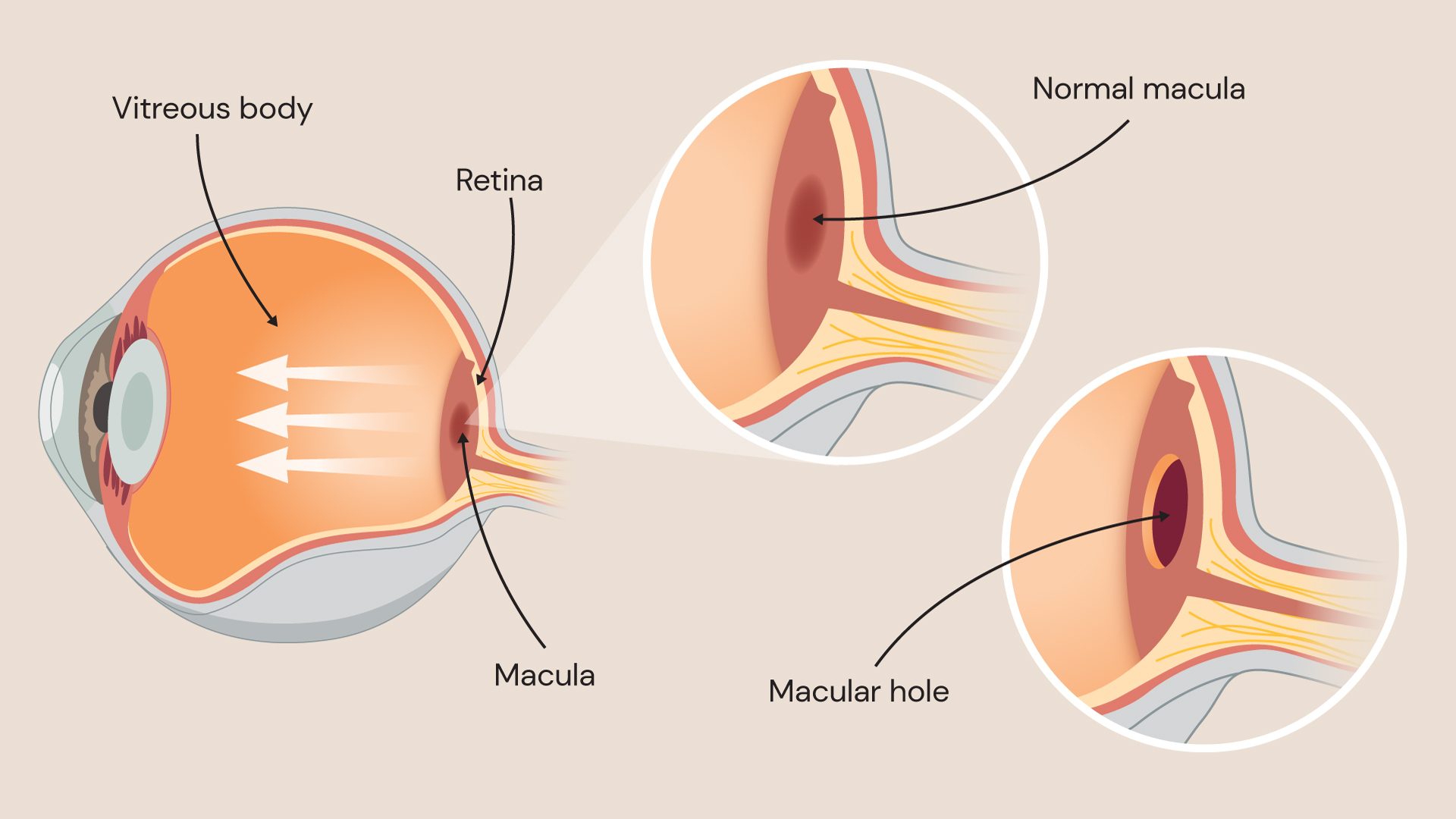
The structure of the eye with a comparison between a normal macula and a macular hole, where a small opening develops in the centre of the retina.
Diagnosing a macular hole
It’s crucial to diagnose macular holes as soon as possible to minimise your risk of complications.
To diagnose a macular hole, we’ll first ask about your symptoms, as well as your medical and family history.
Next, we’ll complete an eye examination where we dilate your pupils (the black holes in the middle of your eyes) to see your retina. Dilation can help us check if you have a tear in your macula.
You may need further tests to confirm a macular hole and examine your retinas more closely.
Tests we may recommend to check for further signs of a macular hole include:
- fundus photography – a non-invasive eye exam that takes pictures of the back of your eye (fundus) while the pupils are dilated
- optical coherence tomography (OCT) scan – a painless exam that takes pictures of the back of your eye using light waves
We’ll discuss your treatment options once we’ve confirmed that you have a macular hole.
Macular hole treatment
Macular holes require treatment to prevent them from worsening and causing permanent damage to central vision.
If the macular hole is quite small, we may take a watch-and-wait approach where we’ll monitor your condition, as an early-stage macular hole can close independently.
However, if your macular hole needs treatment, a vitrectomy is the most effective surgical procedure. We typically perform this surgery under general anaesthesia, so you’ll be asleep throughout.
During a vitrectomy, the surgeon removes some or all of your eye’s vitreous gel and any bits of tissue that may be putting strain on your macula. Next, a sterile gas is put into your eye to press on the macular hole until it heals.
After a vitrectomy, you may need to spend up to a week with your head down to keep the gas bubble in the correct place.
You must also avoid rubbing your eyes, swimming, performing strenuous exercise and wearing eye makeup as this can dislodge the gas bubble.
The gas bubble will stay in your eye for around 5 weeks, temporarily blurring your vision.
Once your eye is fully healed and the gas bubble is absorbed, your vision should improve and your macular hole should close.
Next steps for macular hole treatment
To find out more about the most appropriate treatment options for macular hole, complete our online enquiry form to arrange an appointment with one of our consultants.
Locations
Our private ophthalmology service is located at:
Discover our specialist team of ophthalmologists
We can diagnose and treat macular holes to protect your vision from permanent damage. Our expert team ensures you receive prompt care so you can keep your vision safe.