
Author
A prosthetics expert who lost his arm has become the first patient in the UK to benefit from transformative osseointegration surgery performed by a pioneering multidisciplinary team at St Thomas’ Hospital in London. Now he’s back to doing what he loves best – making and fitting prosthetic devices for NHS patients.
At Guy’s and St Thomas’ Specialist Care, our world-leading multidisciplinary team can now attach prosthetic limbs securely onto a titanium fixture inserted in the bone, enhancing the lives of people with limb differences.
An ideal candidate for innovative surgery
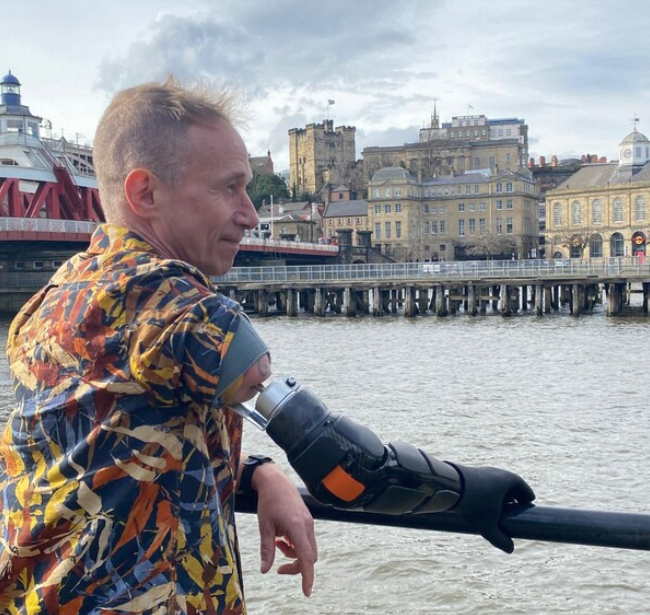
Jim Ashworth-Beaumont, a senior orthotist at the Royal National Orthopaedic Hospital (RNOH) in north London, underwent pioneering osseointegration surgery at St Thomas’ Hospital.
Osseointegration, or direct skeletal fixation, describes the fusion between a titanium implant and bone. It was pioneered by a Swedish orthopaedic surgeon and led to the development of dental implants, paving the way for surgery with larger implants.
While most people will benefit from the many standard prosthetic options available, Jim needed a special activity-specific prosthesis to work in both clinical and workshop settings as well as across all his sport and domestic activities.
Life-changing loss of a limb
The former Royal Marine lost his right arm in 2020 when a devastating accident occurred while on leave from his work in prosthetics and orthotics at RNOH.
The life-altering event happened when Jim was hit by a lorry when riding his bicycle in southeast London. Jim was found in a critical condition, among many severe injuries he’d lost his right arm, and his lungs had collapsed.
The London Air Ambulance flew Jim to King’s College Hospital, where, despite his excellent fitness, the trauma team didn’t expect him to survive. However, luck was on his side.
The team called in Mr Edmund Fitzgerald O’Connor, a skilled consultant plastic and reconstructive surgeon. Mr Fitzgerald O’Connor is the clinical lead for plastic surgery at St Thomas’ Hospital and Kings College Hospital. He’s also an expert in trauma reconstruction and caring for patients after limb loss. He managed Jim’s immediate abdominal wall and limb injuries.
By chance, Mr Fitzgerald O’Connor had also been forming an orthoplastics team at Guy’s and St Thomas’ hospitals. The team combines plastic, reconstructive, orthopaedic and prosthetic expertise to deliver advanced surgical techniques for trauma and cancer patients. They planned to use osseointegration to attach a prosthesis directly to the bone at the site of the amputation.

Osseointegration has the following benefits:
- a titanium implant in the bone creates a more stable, integrated connection between the prosthesis and the body compared to traditional socket prosthetics
- the patient enjoys enhanced sensation and function as the limb feels more natural, and they feel at one with the device
Mr Fitzgerald O’Connor was looking for a suitable patient for osseointegration, and thought Jim could be an ideal candidate due to his experience as an amputee, active lifestyle, and decades of clinical and academic expertise. Mr Fitzgerald O’Connor would play a lead role in Jim’s reconstructive surgeries and pioneering osseointegration surgery.
Osseointegration vs traditional prosthetics
Initially, the surgical team focused on the injuries to Jim’s lungs and liver. He spent 6 weeks in a coma while Mr Fitzgerald O’Connor and the team repaired his abdominal wall. He also spent 6 months on kidney dialysis. Jim spent 18 months regaining his strength, before receiving his first prosthetic limb – a standard device from the NHS.
Jim returned to work, where he made and fitted orthotic and prosthetic devices for people with functional deficits and limb differences. He soon realised that he needed a more versatile prosthetic for his lifestyle. His standard socket prosthesis was heavy and with limited elbow bending and hand movement. It was also challenging to fit and irritated his skin.
Jim tolerated using his standard prosthesis for 1 or 2 hours at a time. He said:
“I work with patients and build devices in the workshop. You have to apply quite a lot of force with a great deal of refinement, but mechanically, my residual limb is quite short. The shorter the limb, the more problematic it is. That’s where osseointegration can be very useful.”
Mr Fitzgerald O’Connor had discussed osseointegration with Jim early on. He said: “Osseointegration is not something you dive straight into because most patients will benefit from and achieve what they want with a standard prosthesis. For patients with higher functionality requirements or those experiencing long-term issues with the standard of care or prosthesis, we can consider osseointegration. For Jim, a heavy shoulder-hung prosthesis with limited function wasn’t allowing him to see and treat his patients well enough.”
Life-changing surgery
At St Thomas’ Hospital, our multidisciplinary orthoplastics team – the only one of its kind in the UK – combines plastic, reconstructive, and orthopaedic and prosthetic expertise to deliver the highest standard of care and long-term results. The team has trained internationally with world leaders in osseointegration to bring the latest surgical techniques to the UK.
After Jim’s innovative surgery, he received gentle physiotherapy to maintain muscle strength and range of movement.
He later underwent a planned period of training with support from his prosthetic team. He gradually increased the weight he applied to the implant to ensure that the bone built around the implant and fused properly.
Jim soon returned to his demanding clinical role just several weeks after surgery, a UK-first for this new integrated approach. He recovered well and experienced none of the associated risks of osseointegration, such as infections, which require antibiotics to treat.
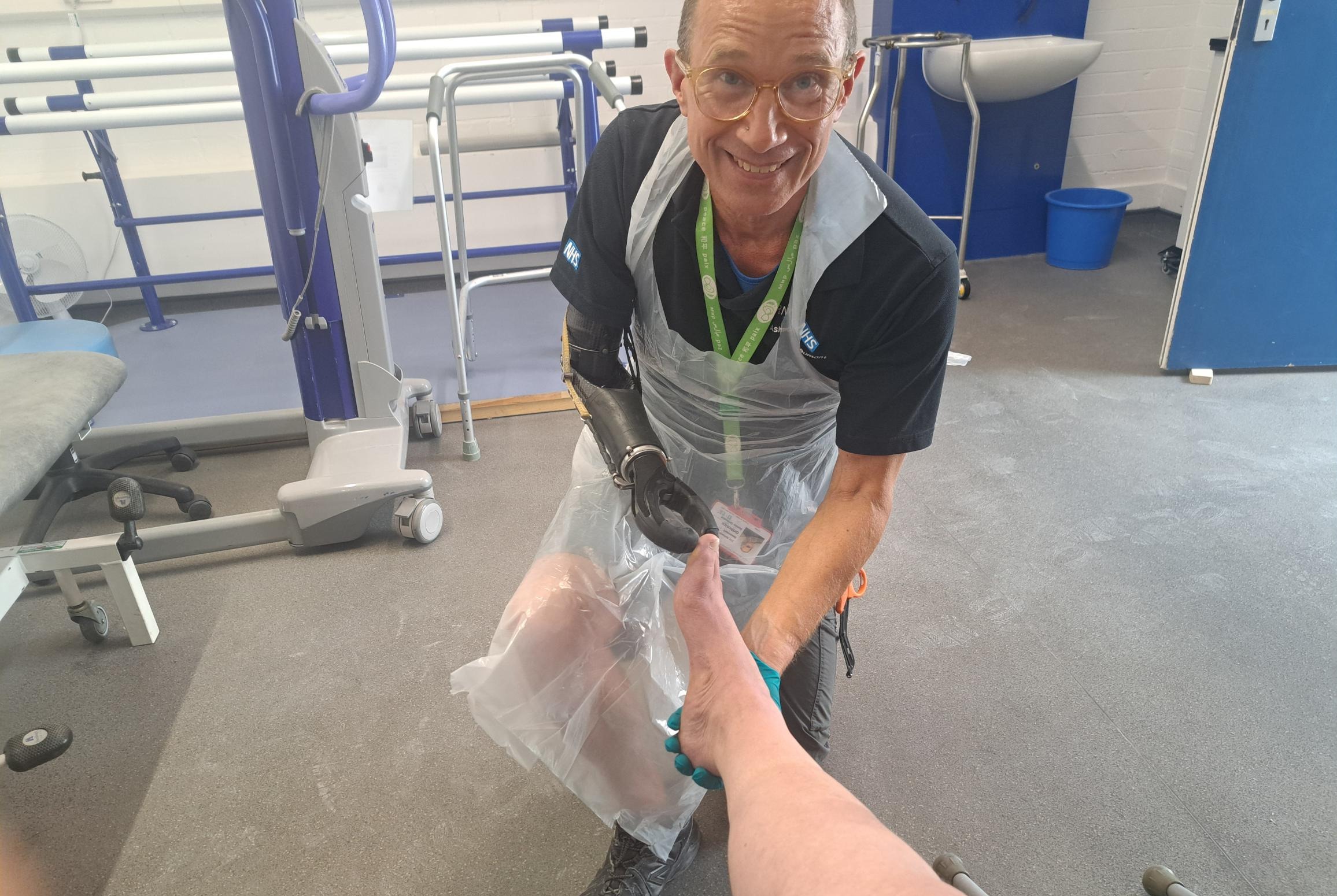
Jim, seen here with a patient of his, returned to his job of building and fitting prosthetic devices, while wearing his own prosthetic arm attached with osseointegration.
Another potential risk is a bone fracture, although this is rare once the implant has integrated into the bone. His team’s unique approach helped to make this outcome rarer still, as Mr Fitzgerald O’Connor explained:
“We are the only multidisciplinary orthoplastics team combining the skills of plastic surgery and orthopaedic surgery at the same time. Our specialist orthopaedic consultants are expert at managing bone and bone problems, while I look after soft tissue. This combined approach, knowledge and understanding means the likelihood of complications can be significantly reduced.”
Experience, recovery and transformation
Of the procedure and the hospital team, Jim said: “The experience of coming into the unit and having the surgery was really smooth. The surgeons, all the clinicians and the fantastic theatre staff were brilliant. You couldn’t ask for more. And the aftercare was great as well.”
Since his groundbreaking osseointegration surgery, Jim has seen a vast improvement at work and in quality of life generally. He’s running regularly, riding a static bike, and swimming.
Jim shares: “You clip the arm on and then off you go. I’m using some sort of arm more or less 100% of my waking hours, compared to about 25-30% before. It feels part of me as soon as I put a device on.”
He adds: “Importantly, the assessment has to be correct. The quality of the clinician is the most important thing, and my surgery has been brilliant.”